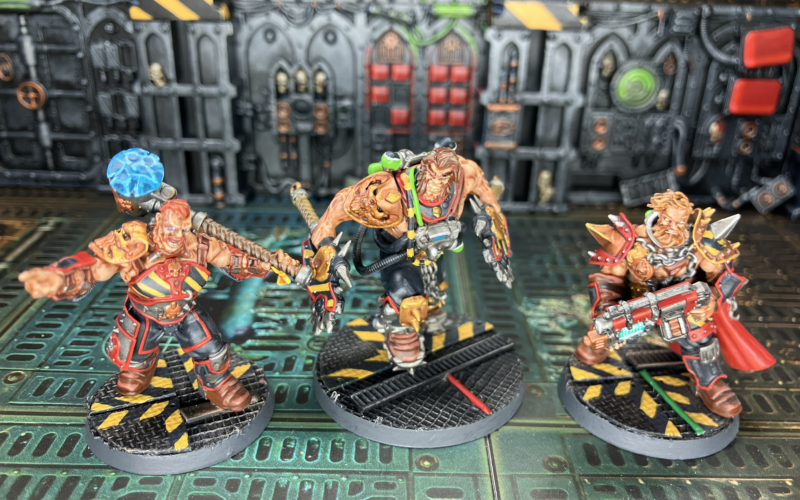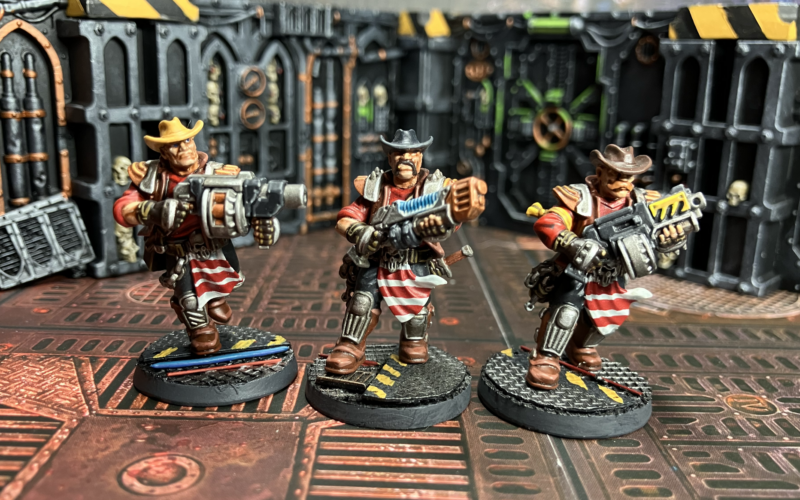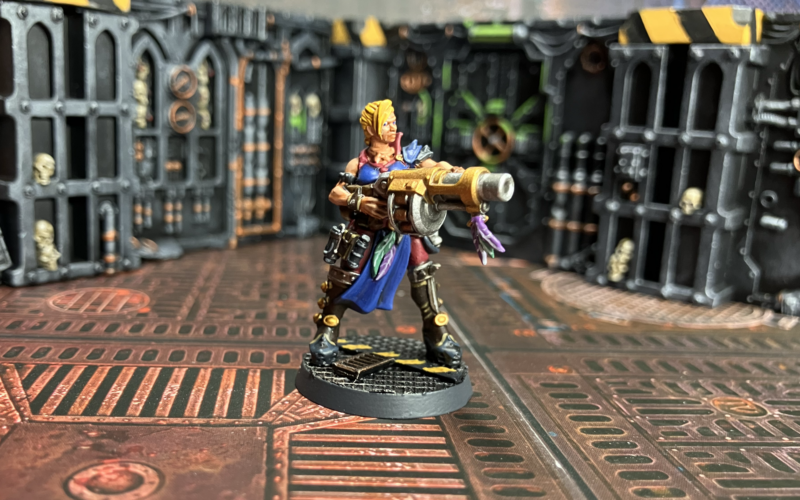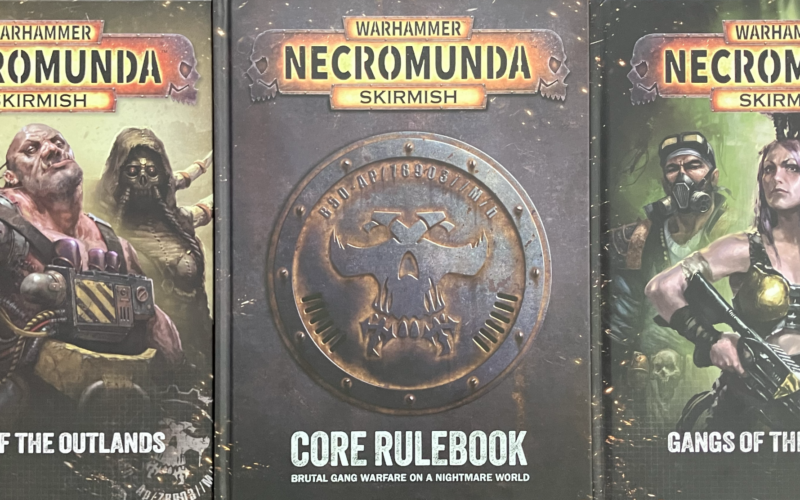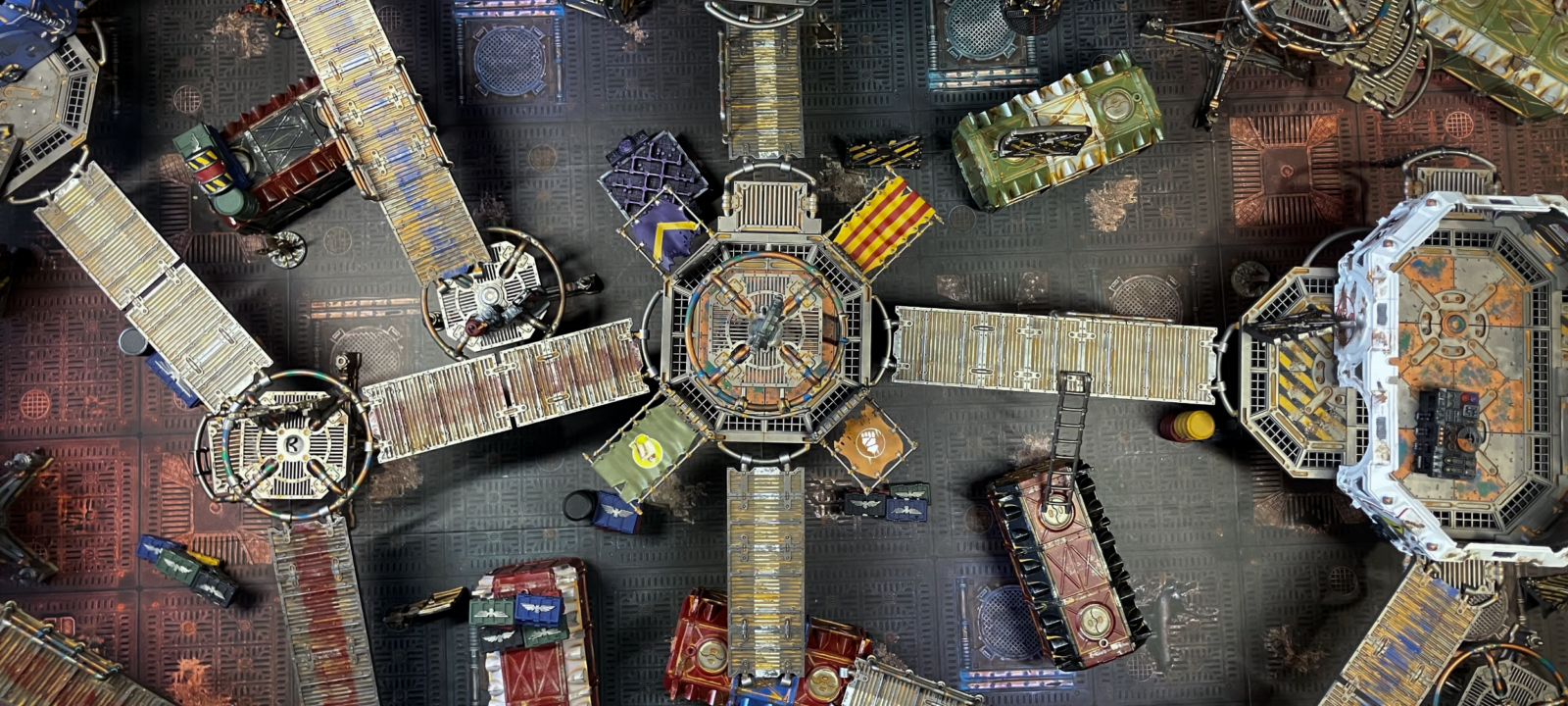
It took about three weeks but I finally got a game of N26 in.
It’s funny because I’ve actually joined a campaign that just started that’s still using the N23 rules. So, expect Papa Ferm’s little boy to be mixing things up on the regular. But, I will say this, the game played even better than I expected. In fact, because of the campaign game and because of my unique employment situation, I actually got to play back-to-back games of N26 against N23. And, because of this, I feel like I have a fairly unique perspective in that I can literally A/B the two systems having played one game after the other.
So, let’s not fuck around with this, yeah? Let’s just dive into it!
List Building
The game that I had scheduled was because I’m the admin on the Hamburg Necromunda Discord and so I play a lot of demo games against people interested in the game but who haven’t committed to it yet. Thus, I tend to build lists with my own miniatures that I think will be fun to play, both for me and for my opponent.
With gangs where I have a wide variety of miniatures painted, I find that the list building is okay but a little colorless. Without Names for Orlocks, the Finesse skillset for Escher, or gene-smithing for Goliath… there just isn’t a lot of daylight between the gangs. Yes, there are small differences but they are just that, small.
Look, in theory, I’m not opposed to fighting two exactly matched forces where the only differences are the miniatures that are on the table. That’s Chess, right? Black or White? It could be Orlocks versus Squats…
But that’s not Necromunda. In Necromunda, at least since N17, each House has character distinct from the other houses which gives each gang a play-style to master above and beyond the game rules themselves. And, unfortunately… that’s been, in a large part, sapped from the game with the new gang books. There are little things like giving the Escher a +1 on Agility rolls but that’s not a fresh way to play a gang, that’s just a bonus in one particular area for particular scenarios.
Now, I will admit, my miniature collection for Goliath is pretty sad. But, still, trying to build a 1000cr demo gang was a little bit soul deadening. It got repetitive fast and I really struggled to come up with something different for each ganger without committing to painting a half-dozen new minis.
But this was just the list building.
How It Played
You can’t really sum up how it played in one short section, so I’m going to break out the various aspects because some of them were very, very good while others were a bit of a shrug, and, at the lowest points, some were disappointing.
Shooting Bad Guys
I will say, the changes to the shooting system are everything I really had hoped they’d be. Declaring a target and shooting at it really is so much faster. And it’s exactly for the reasons I mentioned in the new edition review.
In N23, you had to declare a target and intention. You measured. Short range, long range? No cover? Or light or heavy cover? Plus, plus, minus, plus, minus. Base skill… Three or better to hit.
That’s a slight exaggeration but it’s not too far off, having played N23 right after playing the new edition. All the math is up front and just to see if you hit. Every other roll after that is relatively easy. Strength versus Toughness? Done. Armor? And, finally, injuries.
With N26 that’s inverted. Target a fighter. It’s the BS value or better. Don’t hit? Move on. Hit? Strength vs Toughness. Exceeded? Now let’s do some math… range says it’s long, the target is in some cover… +2 to the save… 6+ base +2 is 4+… roll and see…
For a programmer, this is what we call ‘multiple exit points.’
For a programmer, this is what we call multiple exit points. It’s a chance for the code to bail when the situation stops being relevant long before the potential outcomes are exhausted. Think of it like a telephone survey. No doubt someone’s gotten a call about someone wanting to talk about soap. But, when the age of 35+ is given, the person on the phone thanks them for their time and hangs up. That’s because they’re not interested in responses from people older than 35. Why go through the survey when you know you can bail earlier?
The new shooting system is that in a nutshell. No reason to worry about distance, cover, or other modifiers until you see if you even hit the other fighter. If you did, you can contest the next level. Or the level after. But you only need worry if you ever get there.
While I think I’m on record about complaining about the color that was lost from the removal or all the different kinds of armor, I can also see reducing it to a save because it’s literally the last die roll made after hitting and wounding, which will weed out a lot of further rolls. On the other side, because this has become so much faster, I will say that my opponent and I got through twice as many battle rounds as did my other opponent in the N23 game we played after.
It is a fast and interesting system. So how does that compare to…
Close Combat
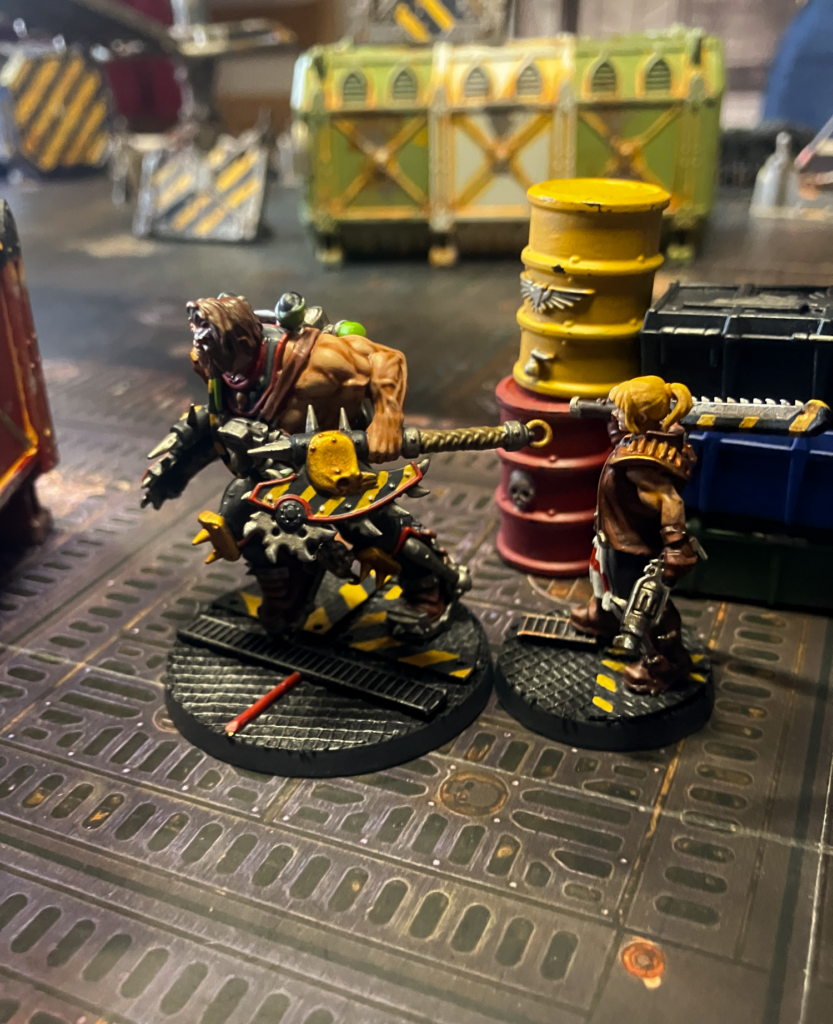
We had several rounds of Close Combat before we remembered the new initiative system but then went over what happened and realized that it didn’t matter. That’s how little has actually changed between one edition and the other. If you charge, you almost always have the initiative-priority and, so, you can attack first.
Where it got interesting was when I had a ganger engaged with my opponent’s leader. It was my activation and I declared a fight action but he actually had a better initiative and, with his single attack, took out my guy before I could land any hits on his. So… that definitely something to beware of!
The only other thing was that I was reminded that Rapid Fire (X) weapons only fire a single round in Close Combat now. And that was a double kick in my balls since I’d rebuilt my Orlock leader to feature a Bolt Pistol rather than a Plasma Pistol with the assumption that what I might lose in raw power I might make up in lots of bullets. But I could not and I did not.
This is a strange change to make and one that, again, strips color from the various build-outs. Yes, a bolt pistol is a strength 4 weapon and that is objectively good. But getting up to three shots, especially for an Orlock leader that only has two base attacks anyway, is what could take them from a middling swordsman (and the graveyards are filled with middling swordsmen, better no swordsman at all) to one who can pack a little punch. It’s even thematic for the Orlocks. They’re generalists. They’re not great at anything. But they do have cheap and ready access to middle-range rapid fire weapons. A pistol would help even the odds a bit in close combat.
I was reminded that Rapid Fire (X) weapons only fire a single round in Close Combat now
But no!
That’s not how it’s done now.
Honestly, if I were to rebuild my Orlock list, not trying to hew as close to the old list as possible but build something totally new with the idea that I’d build new miniatures to match, I don’t know that I’d even attempt a close combat focused Orlock leader. I mean, it was always kind of a lark because, if I’m a gang partisan, I’m an Escher gang partisan, and I like charging in close. Two attacks was never a great stat but with two weapons and a charge, there was always the chance he might overcome. Especially if one was a plasma pistol or a rapid fire bolt pistol.
I like to build champs and leaders with a little bit more of a close combat focus because they have attacks that lower ranked gangers just don’t. And it then feels like a waste to give a guy with 2-3 attacks a heavy bolter which they can shoot once. Maybe.
Then, there was usually a gang name or skill that might help out. But both of those have been excised.
So, given the weapons available to the Orlocks right now (pre-their journal being issued and seeing how the journals even work), I’d say I’d be better off giving the champ a high value, high damage weapon that might only get one or two shots off before it jams or requires a reload than to do close combat. This is mainly because these champ leaders have a matching Ballistic skill stat to go with their Weapon skill and it will always be better than anyone else on the gang.
If I could have one ganger with a shoulder-mounted nuke, Fallout-style, it would be my leader. It might be a one-shot but it would probably be more effective than the currently allowed Orlock close combat build.
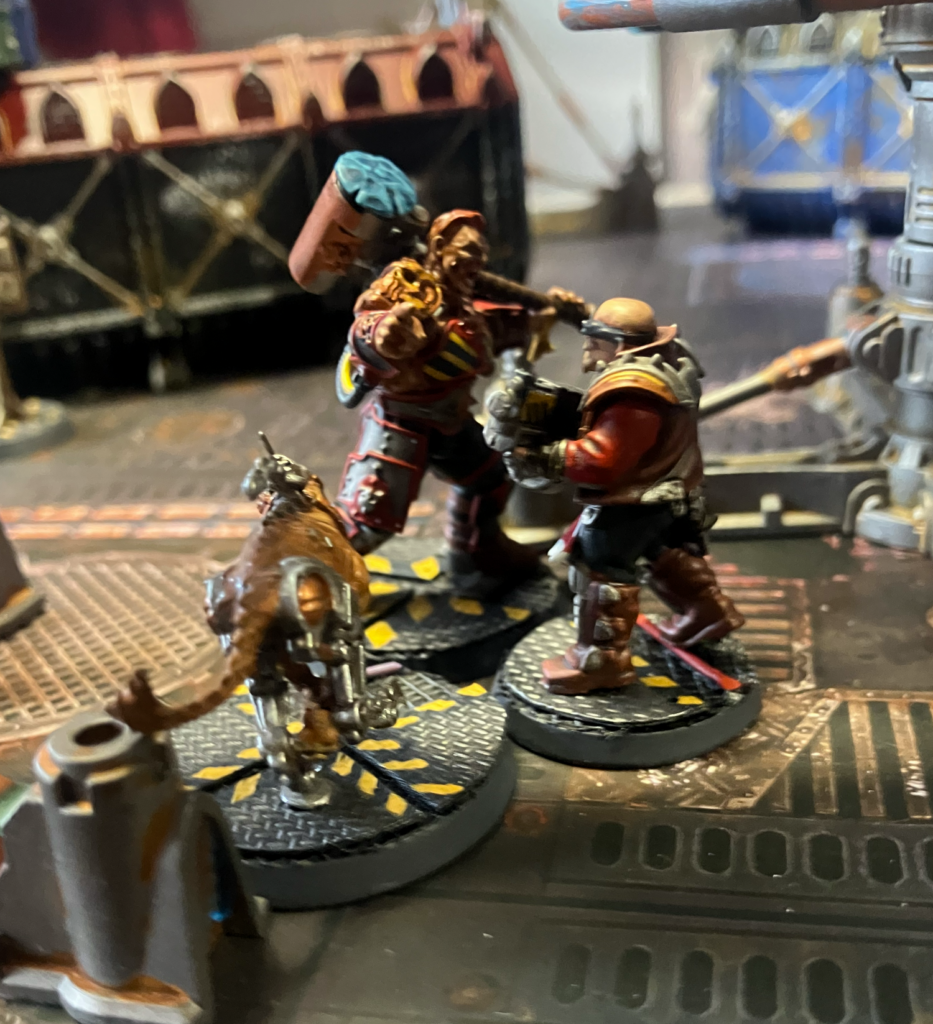
I will be curious to try with the other gangs to see how this works. But removing rapid fire from pistols in close combat is a definite nerf to some gangs. I imagine the Ironhead Squats will be affected in the exact same way. If, for whatever reason, you had a close combat squat leader, expect him to be a lot less useful than before. (I’ll revisit this when I get to rebuilding my 1,200cr squat list.)
Injuries & Wounds
This is probably the last major change between the old edition and the new one: the way taking damage is handled. And this is worth reviewing, just to see the difference.
In the older edition, a fighter had a number of wounds, dictated by the Wounds stat. When a weapon dealt damage, it subtracted from the number of wounds. So a Damage 1 weapon that hit, wounded, and wasn’t saved by armor would remove one wound from the available number of wounds a fighter had. When that number was reduced to zero, it received an injury die roll. For every wound beyond zero, it received an additional injury die roll.
So if an Autogun (D1, Rapid Fire (1)) hit a one wound fighter three times, wounded on all three, and none of the shots were saved, there would be one injury die for reducing the fighter to zero wounds and then two more for each of the wounds below that. You would roll all three and they would all apply. So, if there were three Flesh Wounds, it would reduce their toughness stat by one for each and, unless they were a toughness 4 fighter, take them out of action on reaching Toughness 0. If there were three Seriously Injured results, the fighter would be seriously injured and take two flesh wounds (reducing their toughness by one for each). And if there were three skulls, technically, this would mean there would have to be three Lasting Injuries rolled. (Although, in reality, most groups just played this as a single emphatic out of action.)
it will also happen less often than every other dice roll made in the game so it won’t be so consequential
This has now changed! Of course.
Now, every time you reduce to zero wounds, it’s an injury die. For every wound below zero, it’ll still be another injury die. But, the attacker only picks one result from the dice rolled to apply. A “wound” roll means they can get up next activation. A Serious Injury means they stay face down. Only a skull removes them from the table.
Now, for rapid fire, this does apply to each hit. So if you have the autogun above and hit three times, wound on all three, and your opponent doesn’t save on any, then it’s one injury die for reducing to zero, a totaly separate one for taking them below zero, and then a third separate one for taking them below zero again. In this case, you can roll all three and apply all three effects because each hit is a separate injury dice pool. But if the weapon was Damage (2), say, this would mean you could roll two injury dice per hit but you could only select one outcome per hit pool.
The upside is that this is the very last set of dice rolled and, if you’ve made it this far, it’s worth discussing with your opponent how and why you’re rolling your injury dice because it’s pretty consequential. But it will also happen less often than every other dice roll made in the game so it won’t be so consequential that you have to constantly worry about it.
The last thing I’ll toss into this section is about wounding when falling.
Depending on the terrain you play on, having or not having railings will become much more important as falling off a ledge is a 50/50 chance, as per the Agility check rules unless otherwise stated. And falling over 6-inches is an automatic Out of Action. This can be brutal, especially if playing on Ash Wastes terrain where I don’t think any of the gangways have a half-inch of leeway on either side. Railings do add a +1 to this check. But, otherwise, this could become a really interesting strategy for taking out enemy gangers as you don’t even need to wound them, just “suppress” them in order to force a coin-flip outcome. I don’t love this and I don’t love that over 6-inches it’s just an Out of Action.
I, for one, like to believe in miracles. And if a fighter can’t (possibly) survive a fall from a high distance, what game are we even playing here?
Scenario & Set Up
The old Necromunda had this but then lost it for some reason. But it’s pretty simple, there are four decks of cards, Crews, Deployment, Objective, and Side Jobs. The two gangs in a fight share the first three to determine how many fighters appear, where they appear, and what their goal is. The last is a card dealt to each gang to assign a secret secondary objective.
I saw something somewhere that said with the current available combination of cards, excluding the gang specific side jobs that would be coming with the journals, there were like 42,000 random combinations. Or something. I’m not a mathematician. But it was a lot.
The scenario that it generated was… fine! It was perfectly serviceable.
The scenario that it generated was… fine! It was perfectly serviceable. It got the job done. It gave us each a reason to shoot at one another. But… it wasn’t terribly interesting. Especially since, immediately following, I played Out of the Storm, an Ash Wastes scenario where a storm encroaches closer and closer to a settlement and both the attackers and defenders are hoping not to be caught up in it. One of them was a solid reason to fight. The other was a story acted out over the course of the game.
Since the older version of Necromunda had random scenario cards (and boy, oh boy, did I overpay buying them off of eBay) and now this version has them also, I predict it will only be a matter of time until the pre-built narrative scenarios return. Because that is the bread and butter of the game. I think Games Workshop gets uncomfortable when people mention that Necromunda is the fun parts of a role playing game because they’re a miniature war gaming company. But… eventually, you just have to give in to what your customers want. And, as far as I can tell, having randomly generated scenarios is great but most people want to be telling stories instead of just performing a wrestling match because A-B-C-and-D line up to tell them that this is the match they now have to fight.
Maybe I’m wrong… but I don’t think I will be. They keep experimenting with these cards in most of their systems. And then it’s only a matter of time until it all returns to a storyline where you’re being asked to resolve the consequences. As it should be.
Wrap Up!
I only played a short game of N26. And the game I played was limited, not necessarily by the list building (although that was definitely a thing) but by the models I had available since this was a test game and it’s always more fun to play with painted minis than unpainted.
But with these provisos aside, I can still stay it was a fun game. The shooting was fast and responsive. The only thing that needed to be decided was, was there line of sight? If this was the case then the rest could be worked out later, as the dice rolls required it. Which, most of the time, didn’t need to be figured out at all. So the game just kept going
And that was honestly great. Comparing that to the N23 game I played immediately after, where there was much more discussion about cover, the amount of cover, the bonuses to be applied and the negatives to take away… the N26 rules did successfully streamline a lot of this away and for the better.
Now, are the rules over all better? That, of course, is much harder to say. As I wrote earlier on, there has been a lot of color and character removed from each gang and you do feel that when playing. Maybe not as much as I expected but you do feel the last of differentiation at least a little. The fighting is better. The close combat is… more logical and, yeah… better.
Where I take issue with this edition isn’t with the core rules, it’s basically with the gang rules. Gangs got more simple. But not for the better. Unlike the core rules which were made more simple but also benefitted the game enormously.
I can’t wait to keep playing more games. A guy in my group is launching a beginners campaign and I’m joining in, mostly as a way to keep testing the rules until everyone else catches up. But I can confidently state that I’m cautiously optimistic about this new edition again, with a large “but” being applied until after I have a chance to read the new journals. How and where they let us add or model new equipment will be important as to my overall outlook. But, right now… yeah… I’m pretty happy!