Nothing in this article should be construed to be legal advice. The author is not a lawyer, has no legal training, and doesn’t even reside in the country who’s laws he’s basically talking about. If you are concerned about your liability for copyright infringement, consult an attorney in your jurisdiction who has more training than this monkey.
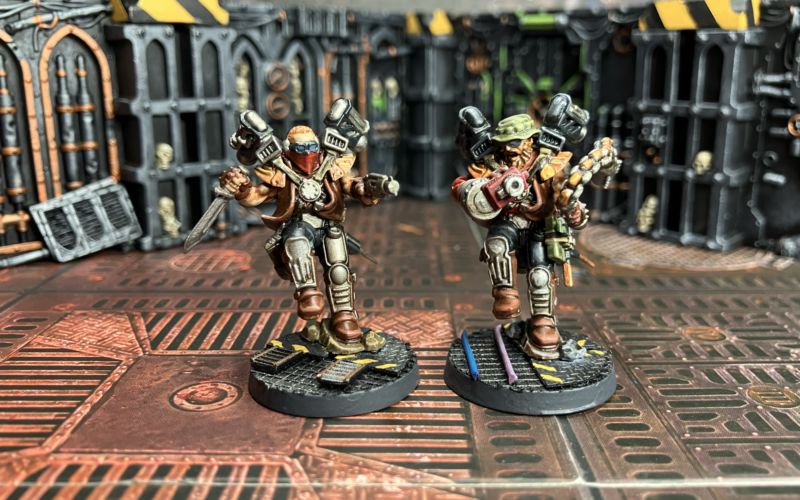
There’s a legal gray area in the hobby scene that I don’t think gets talked about quite as much as maybe it should. And that involves “casting”, the capturing of a model’s detail in some way so it can be re-created in some other way. Anyone who looked at my post about modeling Ash Wastes bikers may have seen in the very front there were some bits in green stuff in the very front.
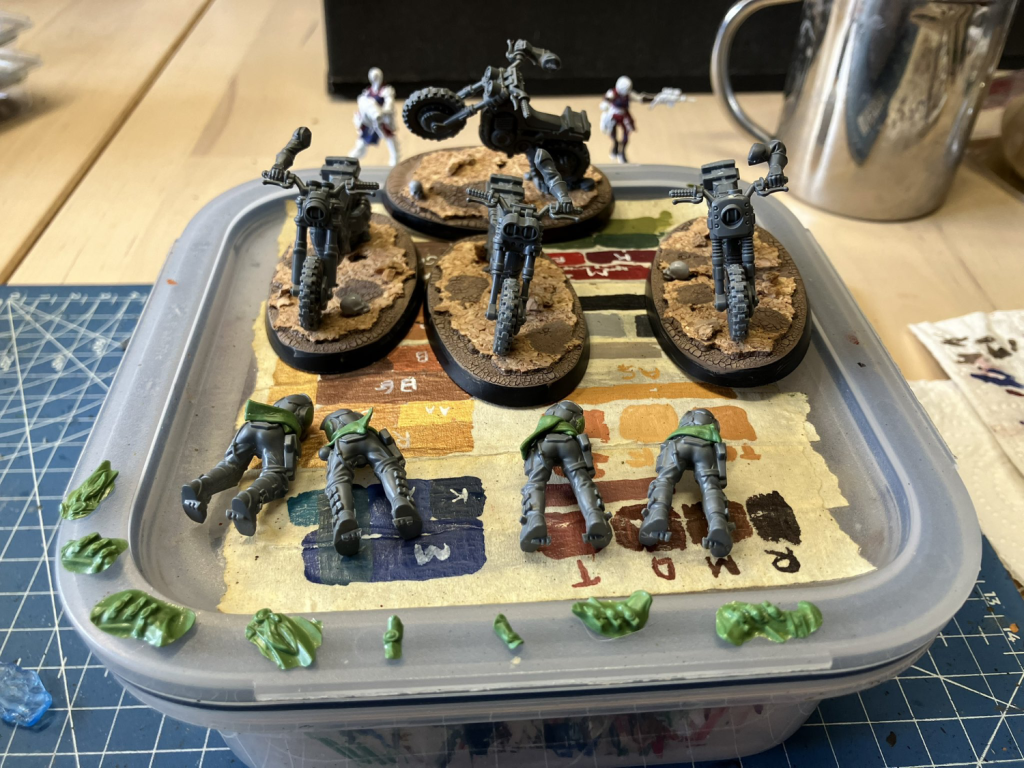
These bits were specifically cast from existing Escher models in order to copy an element I could then glue onto my conversions so they captured some of the Escher vibe. And, love it or hate it, when it comes to Escher minis, feathers and jewels are kind of their thing when it comes to little details.
I did this with with the use of a material sometimes called Blue Stuff. It’s a waxy kind of plastic material that, when heated with boiling water, becomes extremely pliant. Take some softened blue stuff and wrap it around the most detailed part of anything and, when it cools, it will capture that detail in astonishing fidelity.
I’ve really had by best successes with flat details I want to capture and transfer onto something else
Now, it’s not perfect. I’ve really had my best successes with flat details I want to capture and transfer onto something else. I’ve tried to cast whole parts before like, say, a plasma gun and the results were… mixed. That was more out of curiosity before getting a bunch of weapons sprues and realizing I’d never need to ever cast a plasma gun. But at the time, my thought was, if I can capture one well enough, I could put that on a conversion and keep the original safe and sound. It looks pretty good but not good enough that I wanted to use it. I could experiment and try to perfect it but hobby time is sometimes about efficiency, as in, “I have four hours to work on something, am I going to spend that trying to copy a gun or just clip one off a sprue, glue it on, and march this project closer to completion.”
So why would anyone bother with casting if it’s imperfect and time consuming?
Well… if you think of what resources you have that are easy to replace versus resources you have that are hard, putty would be an easy resource and miniatures would be hard. Mostly because of cost and, therefore, rarity. If you’re on a constrained budget and can’t afford to run out to buy a kit packed with plasma guns, it might very well be worth your time and effort to perfect the casting of one. Similarly, if you want to take a detail from a model that only ever existed in metal, it’s essentially impossible to cut up one model to put that detail on another. Even in plastic it’s difficult to make it thin and seamless enough.
I mentioned a “legal gray area” above and perhaps casting an entire weapon versus a detail is where things go from clearly a right to do what you want with something you bought to… is this a copyright issue…? After all, if you can buy a kit with the guns you want, Games Workshop does literally hold the “copy right” to that part.
Now, I’m an American. And in the US we typically have broader protections for this kind of thing. For the lawyers out there, yes, I know fair use is decided on a case by case basis, but there are some things that have become commonly accepted “standards.” It’s why YouTubers, when making a comment video typically don’t use clips longer than 5-10 seconds. A copyright owner can’t prevent any and all reproduction of their work, especially if seeing it is germane to the comment being made. And, in the US, we have broad protections for say, recording a movie off the television if we’re just keeping it to rewatch it at home. When I was a kid, and floppy disks were essentially reliable enough for you to shuffle data from one room to another, it was common that when you bought a program, you copied it onto another disk in case anything happened to the first one. This was just standard.
For the lawyers out there, yes, I know fair use is decided on a case by case basis
And I think this is where things more or less stand in the hobby. You can cast (or re-cast) bits from a miniature you want to use so long as it’s used by you on your miniatures.
Of course, I fully expect to hear from someone saying they were told by someone at their Warhammer store that casting bits is completely illegal and you can’t play in the store with miniatures that use casted parts. But that’s definitely not the case.
Games Workshop may not like casting. It’s in their obvious business interest to discourage casting. It’s their house so they can make the rules as to what minis can be played with on their tables, same as I can deny anyone with a Creed tattoo. But that doesn’t make either the casted part nor the tattoo illegal.
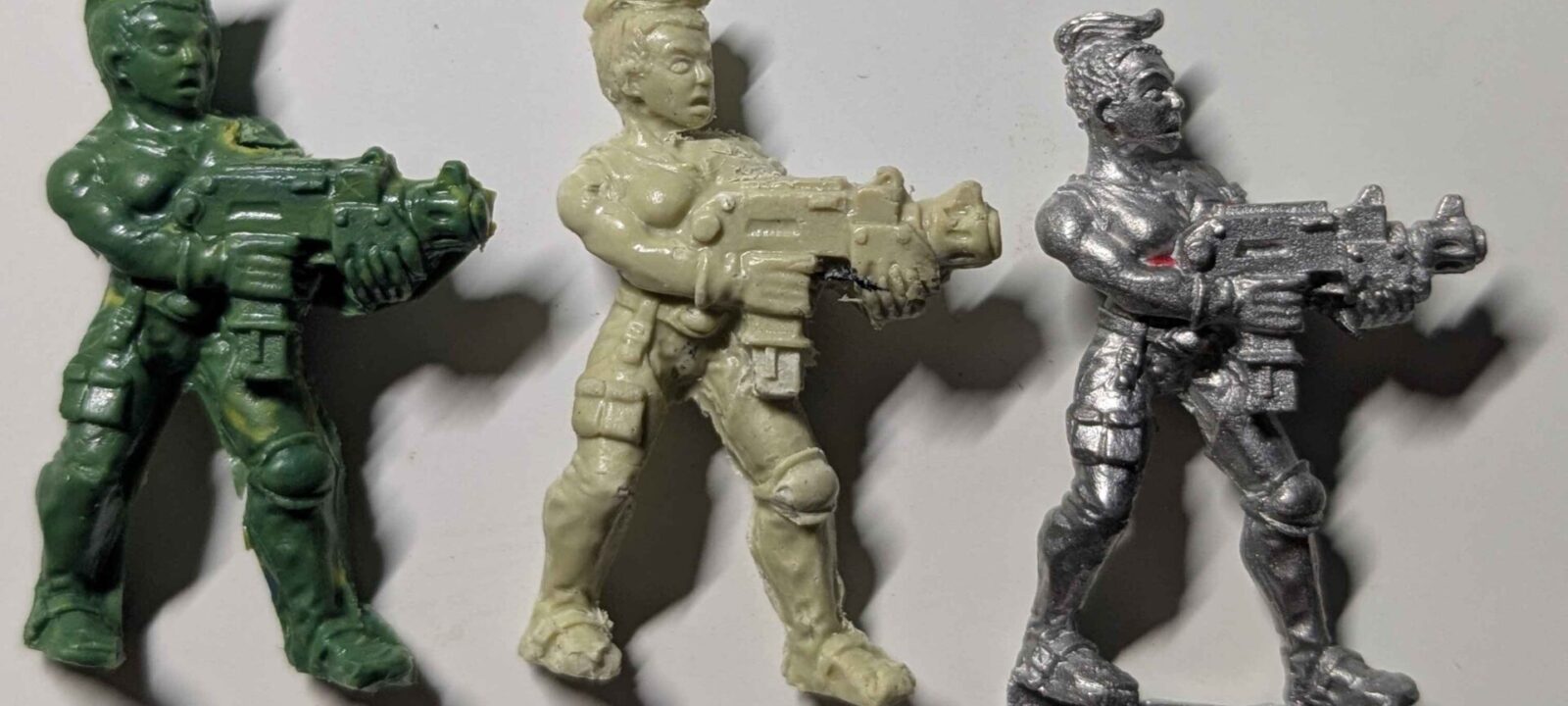
All of which is a big build up to what inspired me to write this bit. A guy in our community wrote me and showed me that he had purchased a Necromunda mini from back in the 90’s, when the music was good and I was still young enough to leave the house after 7pm to see it played. He had conversion ideas but was obviously hesitant to start cutting up a classic metal mini. So I pointed him to Blue Stuff and gave him a quick rundown on how to use it.
Below are the evolving results!
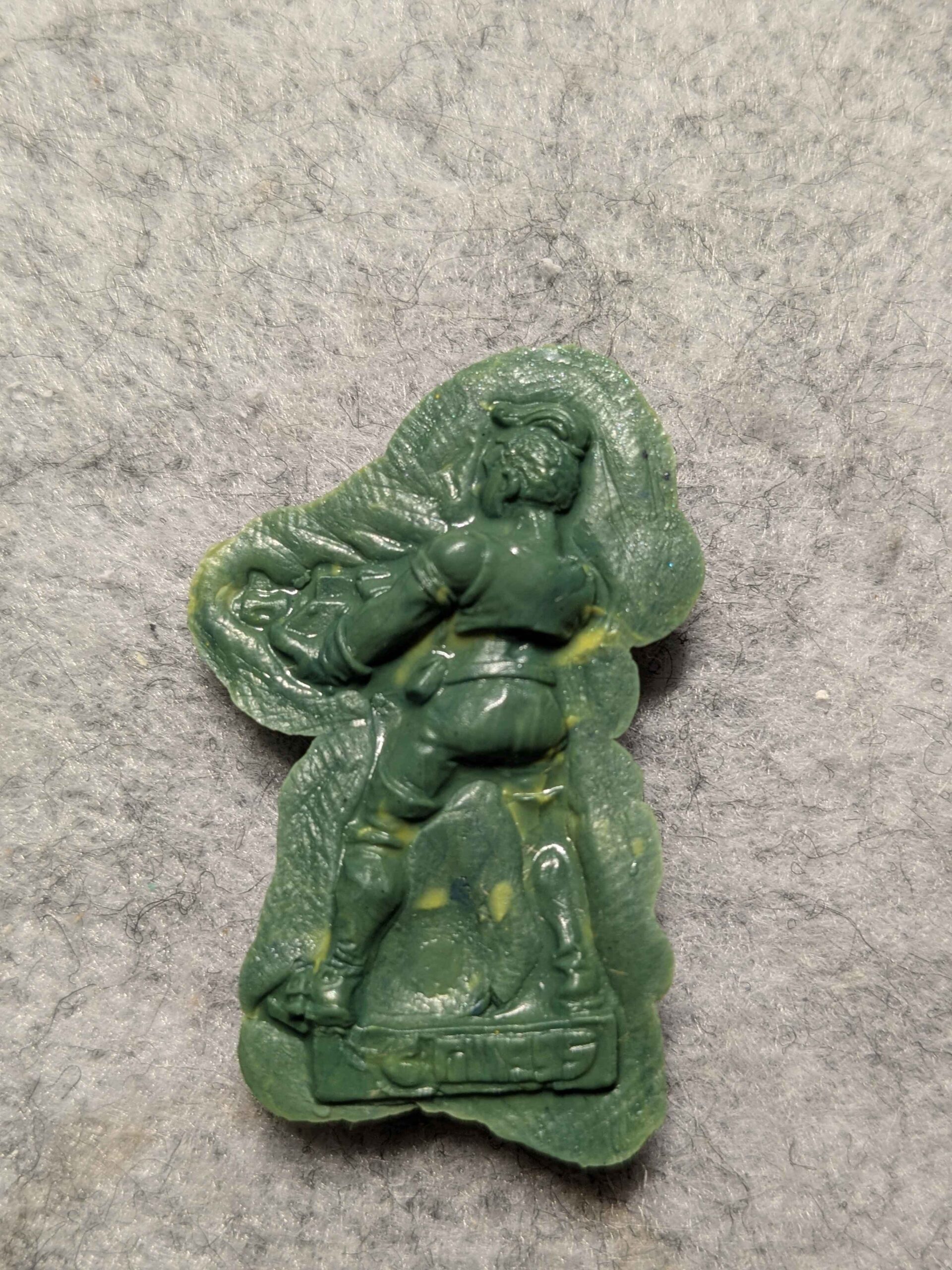
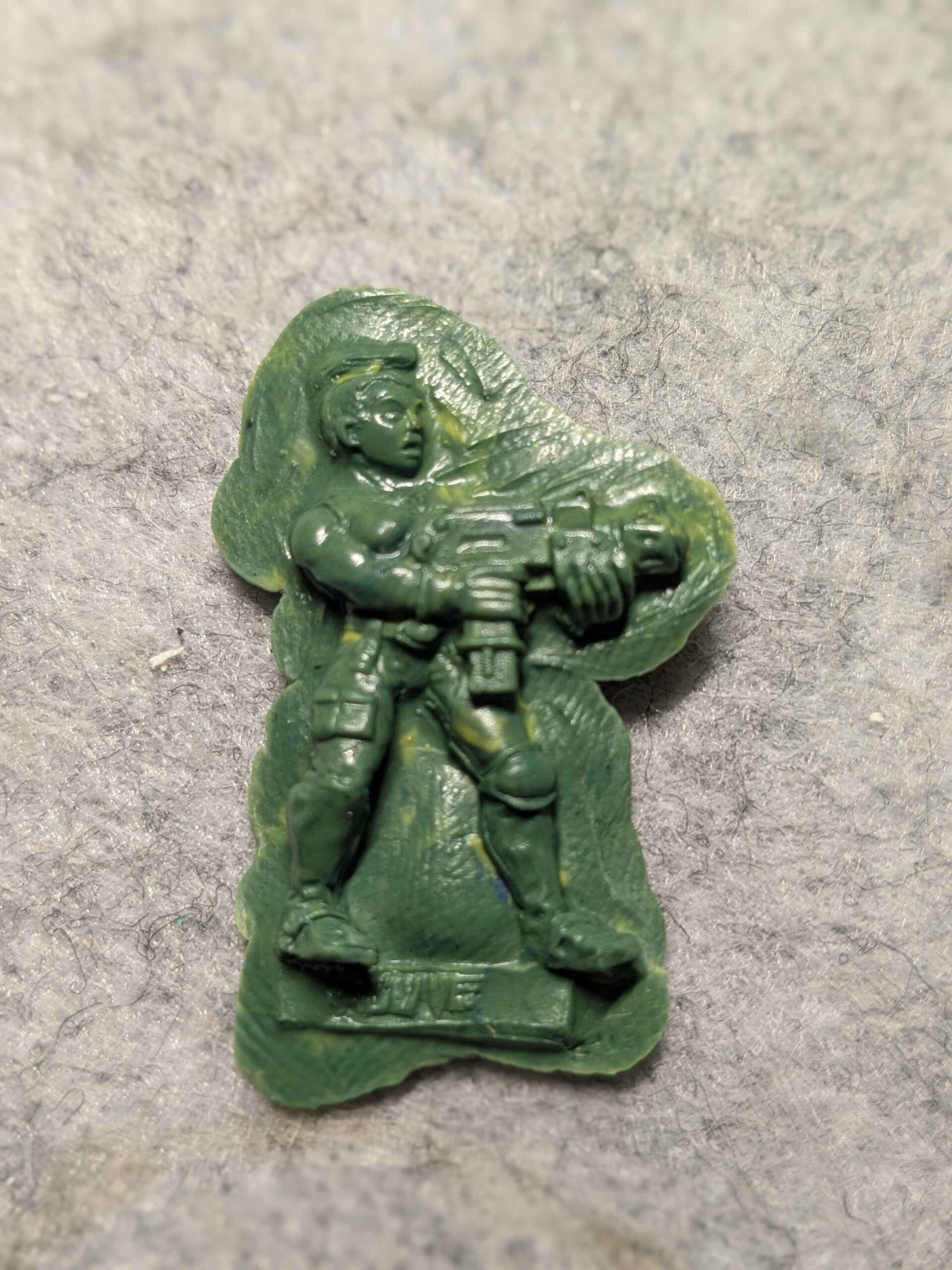
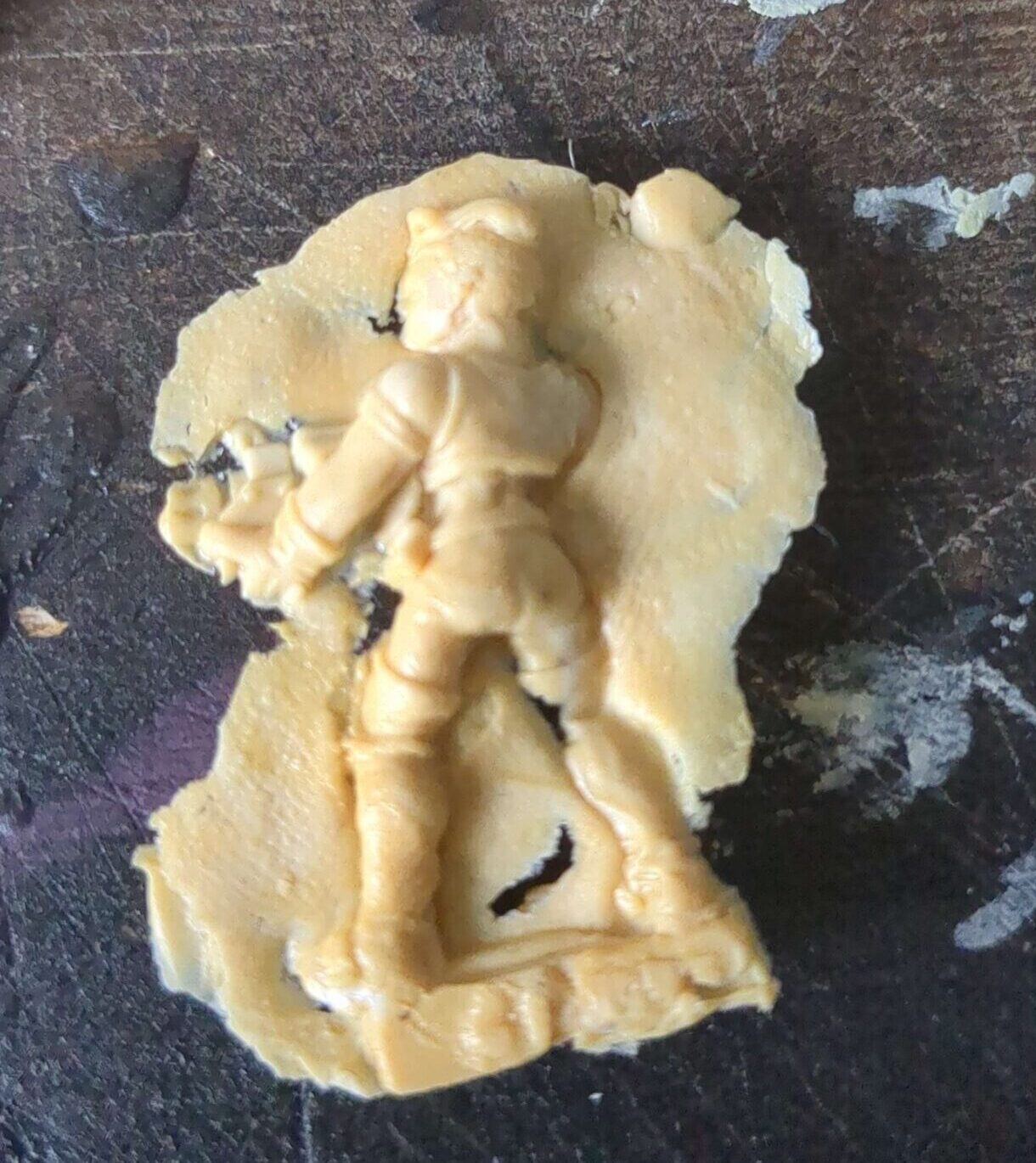
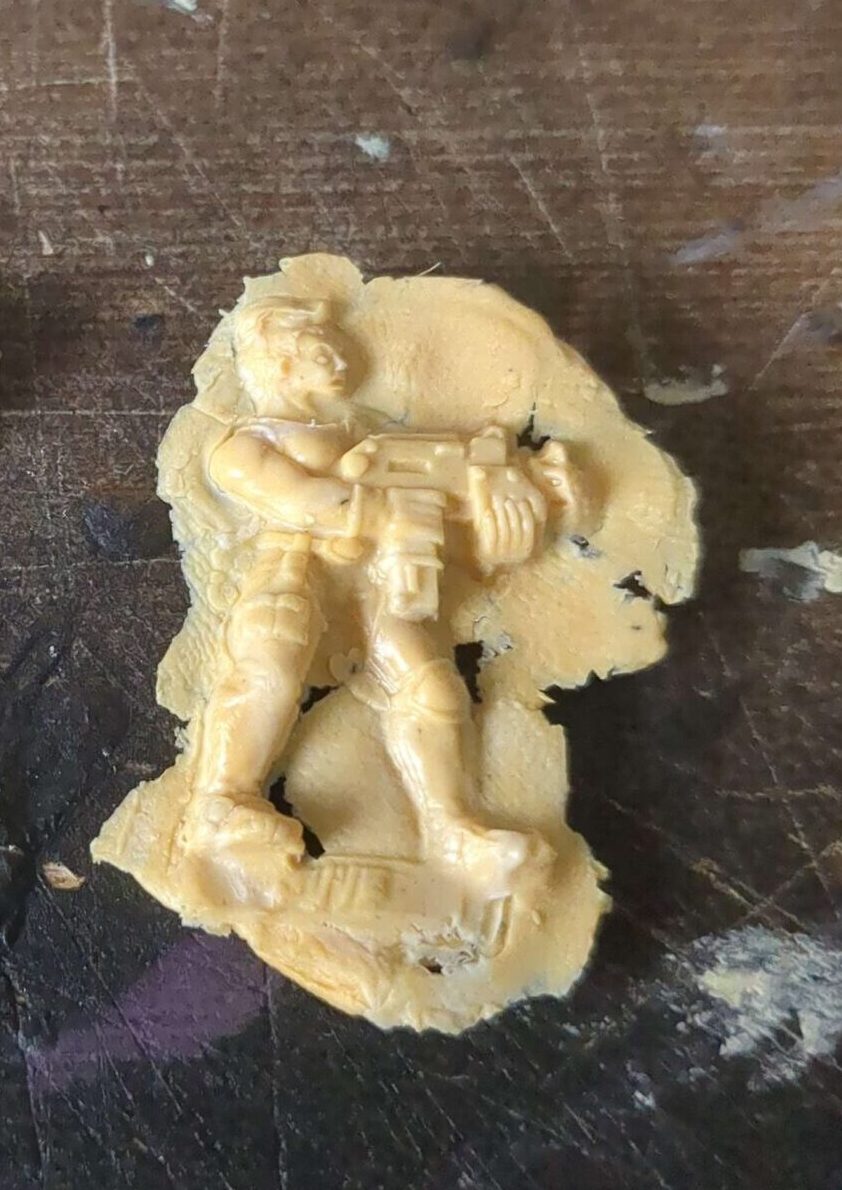
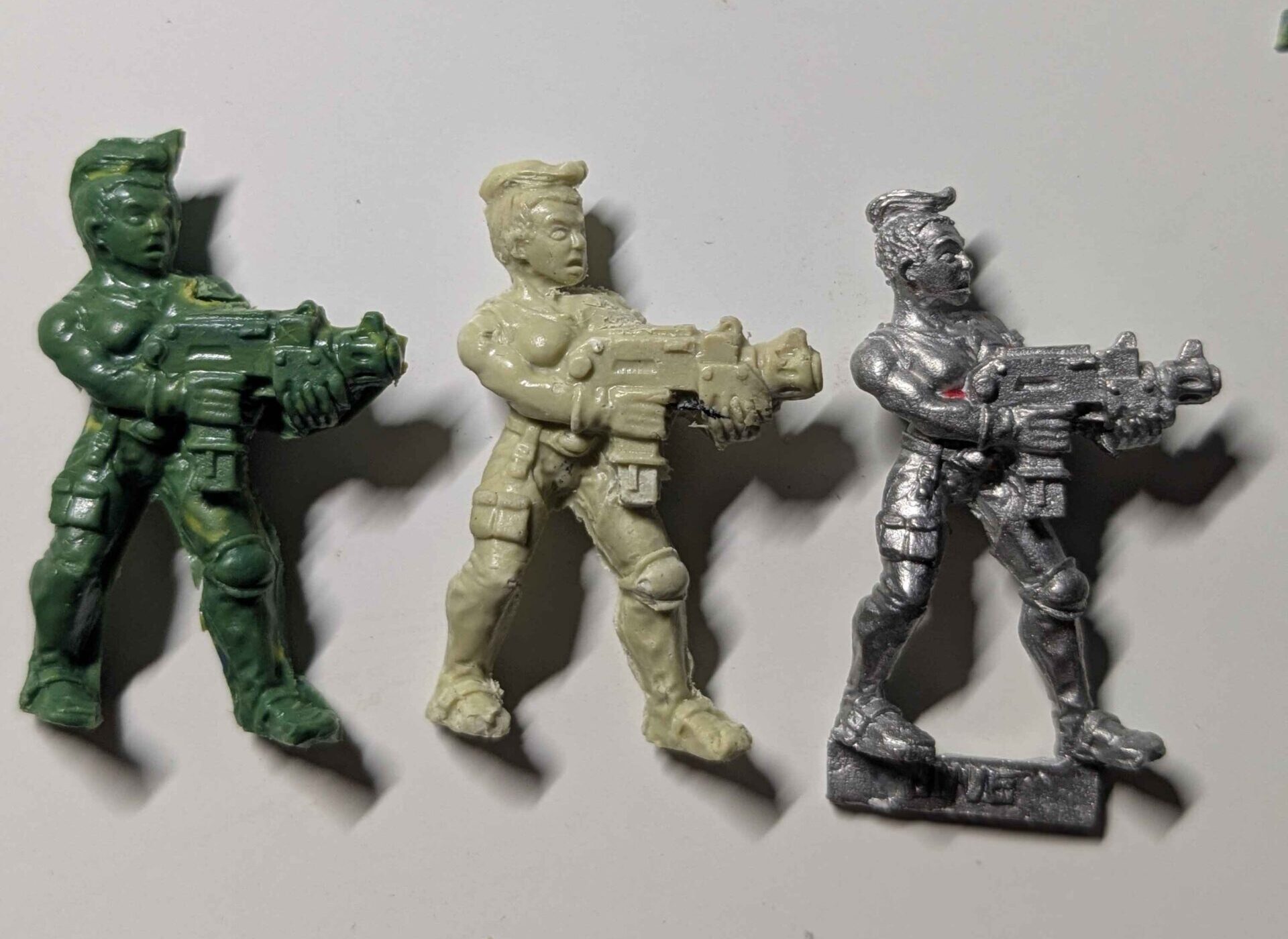
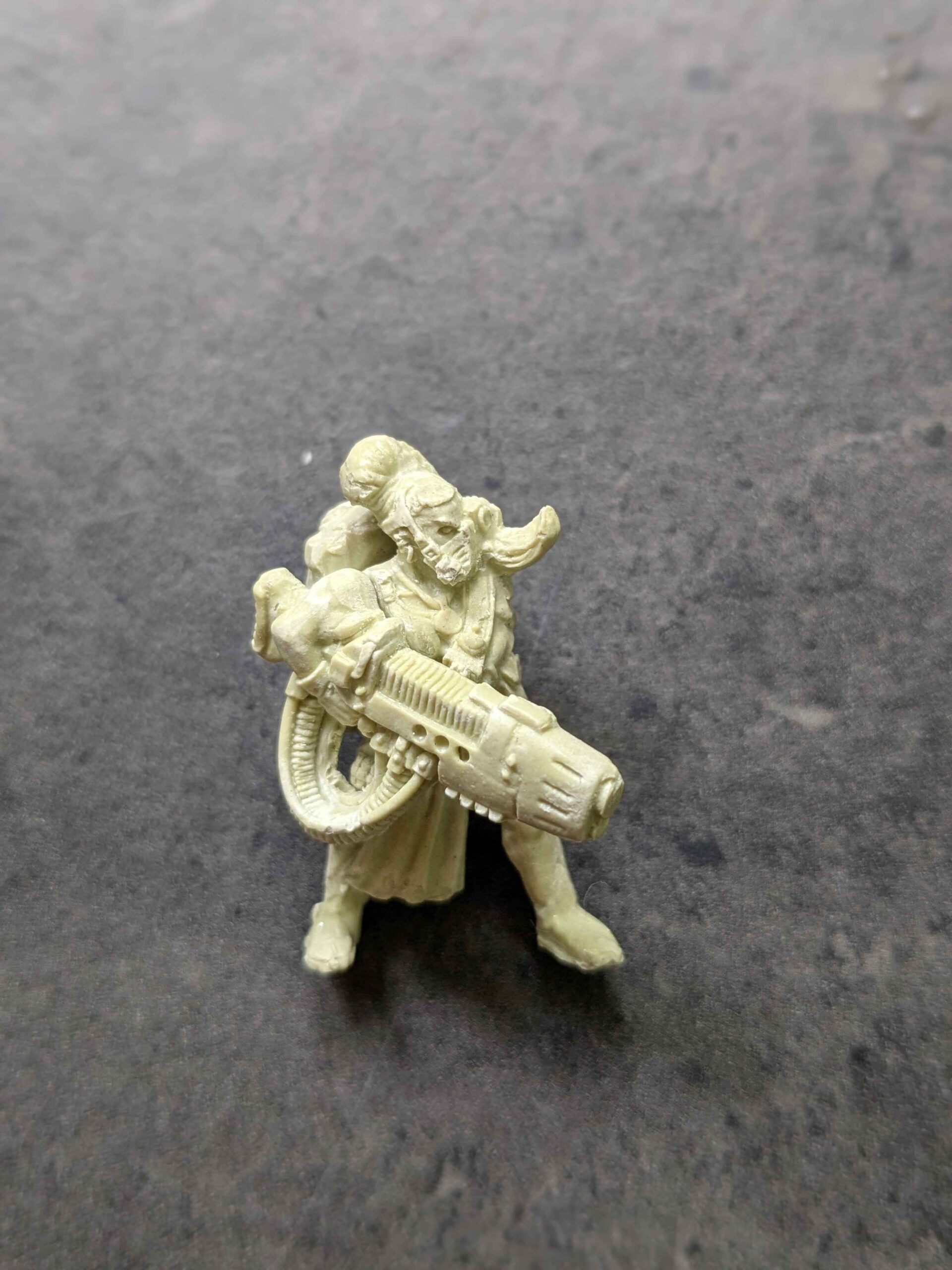
But where does this stand in the legal gray area that is casting?
Well… what’s funny is the guy who did this is a lawyer himself. And we talked about it a bit. And I think where we came down was that casting a whole miniature for personal use is probably okay–even in the EU.
It’s hard to imagine a one-off copy for personal use is going to attract any attention. And, though this has no legal bearing, I’m a lot less concerned, morally, with casting a long out of print miniature than I am the latest hotness. This casting cost Games Workshop nothing. They haven’t made these miniatures in close to thirty years, they haven’t indicated they’re going to again, and the secondary market has no legitimate copyright interest.
But, and this is key to it all, there may other intellectual property right interests beyond basic copyright. I’ve since learned that, in Germany and the EU, there are protected designs that last for 25 years. This particular model wouldn’t count since it’s from the 90’s and pre-EU. But this guy has his design protected among many, many others. One assumes it’s so I don’t get out there, design my own with subtle differences and say, “Ah, but those are the Golden Arches! These are the Golden Arcs!”
Anyway… there are definitely a lot of legal technicalities but what it comes down to is, broadly speaking, casting for personal use should be legal in almost any jurisdiction. Just keep it non-commercial.
So then… get out there! Get some Blue Stuff and try transferring your favorite details from one miniature to another. You’ll probably love the results… eventually.
Oh, and one last hot tip… Blue Stuff is cheap. If you make a really good mold, just keep it. Put it in a bag somewhere so you don’t have to take another impression that may not be as good. And then you can re-create it at any time.