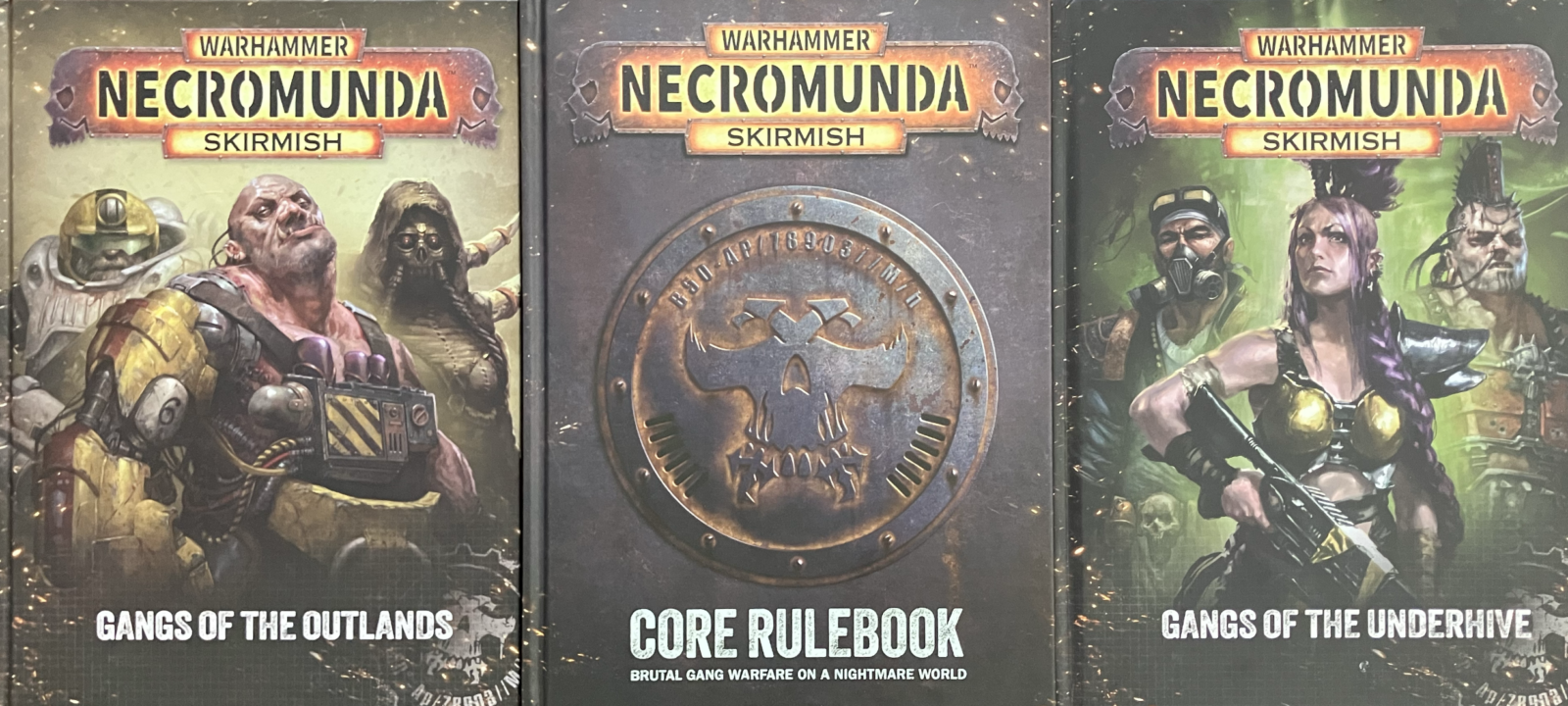
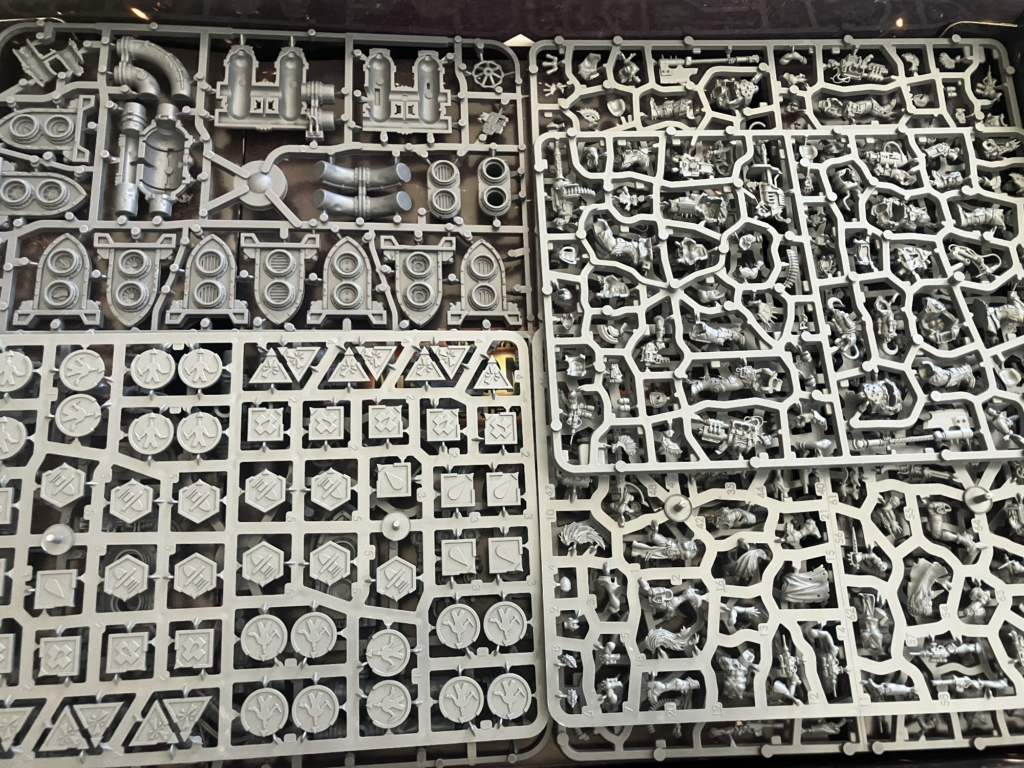
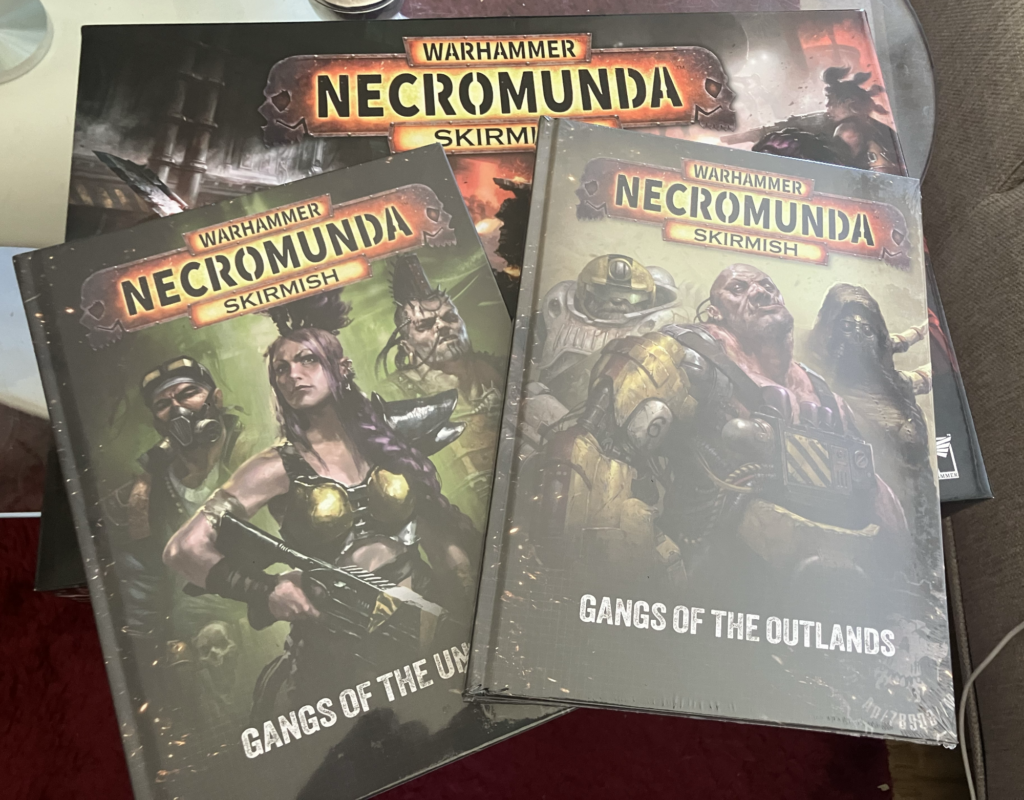
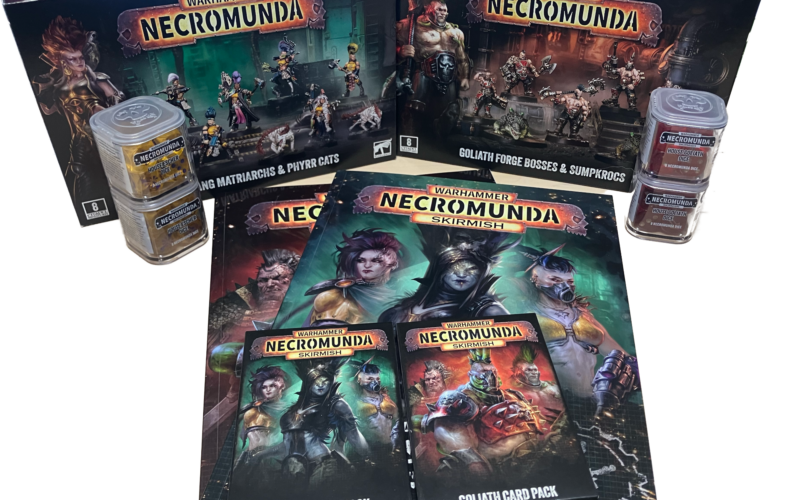
I was lucky enough to pre-order my Necromunda:Skirmish:Warhammer box through a game store here in Germany that shipped out their copies on the Thursday before release so that mine arrived on Friday, which has given me three whole days to go through everything before sitting down to compose my thoughts on it.
But… before I get rolling, I’d like to preface everything I’m about to write with the fact that I haven’t yet had a chance to play a game of Warhammer:Necromunda:Skirmish. So any criticism I make of any of the new rolling systems could be entirely unfounded. Conversely, it’s also entirely possible that things I praise turn out to be complete garbage. To some extent, this is like sitting down with the rules to Monopoly and trying to decide, just from turn order and possible actions, whether the game will be any fun. I have a slight advantage over this scenario in that I’ve played the old version of Necromunda extensively so what I’m really looking for are differences instead of trying to imagine an entirely new game.
Let’s dive in, starting with…
Basic Mechanics
There are some basic changes just to how the game mechanics work. Some of this has been covered but not quite in the exhaustive manner that I like to do things. But the A-Number-One thing that’s changed is the “action economy”. Say goodbye to the confusing system of Basic, Simple, and Double actions. Which is great! Basic and Simple actions were always actions that only used one of your fighter’s two available actions but one of them could be done twice (like Run) and one of them could only be done once (like Shoot or Fight). Which was which? Honestly, after years of playing, I still have no clue. As you play, you just learn which ones can be done twice and which can’t.
Well, that problem is solved now.
Now you still have two actions, a Single Action or a Double Action and any action can only be done once per activation.
The Simple (or was it Basic) activation problem is solved by making the things that were often done twice (like a Run-Run) into a Double Action. So Run-Run has now become a Dash Double Action. But that’s also changed a little bit. Now it’s not twice your movement stat. Now it’s your Movement plus your Initiative value. When you used to pair an Aim action with a Shoot action, that has now been combined into an Aimed Shot Double Action.
it seems to me that Agility should be more than a coin-flip. It’s a very odd way to determine whether someone can or cannot do something
Functionally, this doesn’t change a lot since it’s just combining things that were commonly combined into something new. But the way they’ve tweaked it, leaves me a little conflicted.
Take the updated Move-Move action, Dash. Maybe it adds a little bit more diversity between fast and slow gangs but, while it hasn’t done much to speed up fast gangs (your average Escher sister has a Movement of 5″ and an Initiative of 4, so technically, they’re 1″ slower now on a Dash), a gang like the Squats who still have a Movement of 4″ but an Initiative of only 2 is now very slow, not just in comparison but also on the table. So… that’s weird.
There have been some things added that I’m not conflicted about. They’ve added an Engage action that allows a fighter to move d6″ toward an opponent to, literally, engage them and then make a free Fight or Coup de Grace action. This is great since I can’t count the number of times I’ve stood up a fighter but can’t attack a guy two inches away because I don’t have a second action to do a charge with. Similarly (and I’ll discuss it further when I get to weapons), reload is now just an action. If your gun doesn’t have an Ammo(X) trait, you just declare a Reload Single Action and your gun is reloaded, no more dice checks.
There are also some strange mechanical changes. The concept of agility used to be tied up with the Initiative stat. Formerly, if jumping over a gap larger than your base, it required an Initiative check, as did not falling for whatever reason, or getting knocked down off a mount. Escher always had pretty good initiative so they could generally move around high places relatively safely whereas my Outcast gangs were more of a crap-shoot. Now Agility is just always a 4+. Escher, in the Gangs of the Underhive book are then assigned the special rule Nimble that gives them a +1 to Agility tests and the ability to re-roll natural 1s.
I don’t hate this for Escher but it seems to me that Agility should be more than a coin-flip. It’s a very odd way to determine whether someone can or cannot do something. Imagine playing D&D and you try to leap from here to there and, rather than consult your stats and plan out any modifiers, the DM shrugs and tells you to flip a coin. It feels surprisingly low effort for a stat that could be important.
I get that part of the brief for N26 (as it shall now be called) was “simplification” but if they wanted to differentiate agility from initiative, they could have added a stat for agility much as they added a stat for passing in Blood Bowl 2020.
Anyway…
Shooting Actions
This is the area where everyone has speculated the most and which probably saw the biggest changes. Until… well… a minute ago, the way it always worked was that weapons had a short range, a long range, and possible hit modifiers for both. You always rolled an ammo dice, even if there was no Rapid Fire because this was Necromunda, your gun might’ve been built from rusty spare parts, and the ammo symbol meant your gun might be jammed.
Well… that’s all changed!
And here is where I remind readers that I have not yet had a chance to play the game yet. So it could be great! But it’s definitely different.
Now each weapon profile has a short range and a long range. This only really matters when it comes to cover. Which doesn’t matter now because cover doesn’t affect hits, just saves. Oh, and a natural 6 rolled always hits.
Gone are the days when you had to determine whether a fighter was in partial or heavy cover and this no longer affects the hit roll
So the order would now work like this: Declare a target, measure the distance, and roll to hit. If hit, make a Wound roll, which continues to work as it always has. If wounded, then make a Save roll, which has now replaced the Armor roll. Every fighter now has a Save stat built into their profile. Some are better, some are worse, but the baseline is 6+, the same as the old-school Flak armor save. The Save roll can be modified by armor (Mesh adds a +1), and whether in cover (+1 for being in the weapon’s short range, +2 for being in long range). So a base 6+ save on a fighter in cover at long range with mesh armor would save on a 3+. Which is as good as you can get since a 1 or 2 always fails.
Gone are the days when you had to determine whether a fighter was in partial or heavy cover and this no longer affects the hit roll. If someone’s head is the only thing showing above cover (what used to be called “Heavy Cover”) and you have a 4+ Ballistic Skill, you hit them on a 4+. If they’re within short range, they only get a +1 to their base save.
Oh, and you only ever have to check for ammo if your weapon has the Rapid Fire (X) or Ammo (X) traits. If they don’t, you can just keep on shooting.
This is the part I’m most uncertain about. And I don’t really care about it from a mechanic standpoint but, rather, from a storytelling perspective. Necromunda is supposed to be the story of desperate gangers fighting it out with limited resources in the nightmarish underhive. It seems to me that popping off random shots that will never hit is basically like a gang war in South Central LA. A lot of bullets flying but not a lot of people dropping. Instead, these rules have essentially leaned into a lot more people getting hit (what with the 6 always succeeding on the hit-roll) and a lot fewer saves (since 2/3rds of the dice rolls are statistically ones or twos).
I can see where this makes fights “faster” since there’s less calculation upfront with the whole “short range plus one, heavy cover, minus two, BS of five so… sixes to hit” that was part of every shot taken in every game. Now it’s, “him, within short range, BS four-up” and you roll. Then you roll strength versus toughness, and only then do you say, “okay, base save six-plus, in cover, short range save is five, armor, save is four.” So all the math is saved to the end. Which isn’t terrible. But it does flip things on its head a bit.
Close Combat
While shooting has sucked up a lot of the oxygen in the room, the area I was most curious about was close combat for the simple reason that it’s my favorite part of the game.
When planned out my first Escher gang, I designed a champion with a needle rifle thinking the toxin weapon would be a lot of fun against multi-wound enemies. After a couple of games what it turned out to be was fucking boring. My favorite part of the game always involved my Death Maiden running over to some sucker and really ruining their day. With a needle pistol and a venom claw, the extra actions from having two weapons and a charge, I often found myself rolling up to six injury dice. It was brutal but, Christ Jesus, was it glorious!
A buddy of mine does the same thing but with his Goliath Stimmer. I hate being on the receiving end of that fucker but, boy howdy, do I understand the pleasure.
So when I started reading things about close combat happening in “Initiative order” I got curious.
So what’s changed?
Unlike before where a fighter could have two weapons but attacks had to be divided evenly across them (excepting pistols that only ever got one attack) now you designate a primary and a secondary weapon. The primary weapon gets the number of attacks equal to the fighter’s Attack stat, +1 if they charged. The secondary weapon only gets one attack, no matter what. This is interesting because it doesn’t change the equation at all for fighters armed with a pistol and a sword. But it does make it a little more interesting for my Escher Death Maiden that has a stiletto sword and venom claw.
The new stats give a Stiletto Sword a -1 AP, a “lethality” of 1, and it has the Parry and Toxin (3+) traits. The Venom Claw has the same lethality, a -2 AP, and Shred (5+) and Toxin (3+). Shred is an interesting new trait. Essentially, it increases lethality by 1 if the wound roll is the target number or higher. Given this, it seems like the Venom Claw would always be the primary weapon. But since a Death Maiden has a base 5+ save, this also improves all her close combat saves to 4+ without any armor. That’s old-school Light Carapace territory, which is a save I wouldn’t hate.
Anyway… once weapons are selected and targets declared, the initiative order is decided. If either of a fighter’s weapons have the Unwieldy trait, their Initiative drops to 1. If the fighter successfully charged, they add two to their Initiative. Then, the highest fighter goes first. In the case of a tie, it’s assumed they’re hitting each other at the same time, in some kind of Three Stooges parody, I guess. But this probably won’t happen a whole lot.
So am I liking these changes? Yes, actually. In theory, I’m liking them quite a lot.
Then it’s a roll against the fighter’s Weapon Skill stat (plus or minus modifiers for assistance or interference) and, like shooting, a 1 always fails and a 6 always succeeds. And then the wounding/save rolls are made as I described above.
Now, this actually seems like a fun new mechanic and I’ll tell you why!
A Death Maiden has a base Initiative of 5. A Goliath Stimmer has a base Initiative of 4. With one improvement to her Initiative, a Death Maiden could tie a charging Stimmer and the result would be simultaneous attacks! And since both sides get to fully resolve their attacks before anyone goes out of action, this could result in mutual destruction of the most hilarious kind.
There are a couple of provisos to this. Firstly, the activated fighter gets to use all of their attacks and both of their weapons. The fighter being attacked only gets to respond with a single attack with their primary weapon. So it would take a relatively lucky hit. But it would be possible.
So am I liking these changes? Yes, actually. In theory, I’m liking them quite a lot. The fun thing about this is that it provides a small counter balance to the previous problem of “first to charge, first to kill” where the outcome of a Death Maiden versus a Stimmer is entirely down to who wins the initiative roll at the beginning of the round. If the Death Maiden were lucky enough to improve her Initiative twice (more on this later down), she could actually strike the Stimmer first even if he charged and, with a couple of lucky rolls with the Venom Claw, could stop him in his tracks before he even gets an attack in.
There are a lot of interesting narrative possibilities with this and I’m here for them. Close combat reads to have changed for the better without making it a lot more complicated, so I think this is one area where the game is much improved versus the previous version.
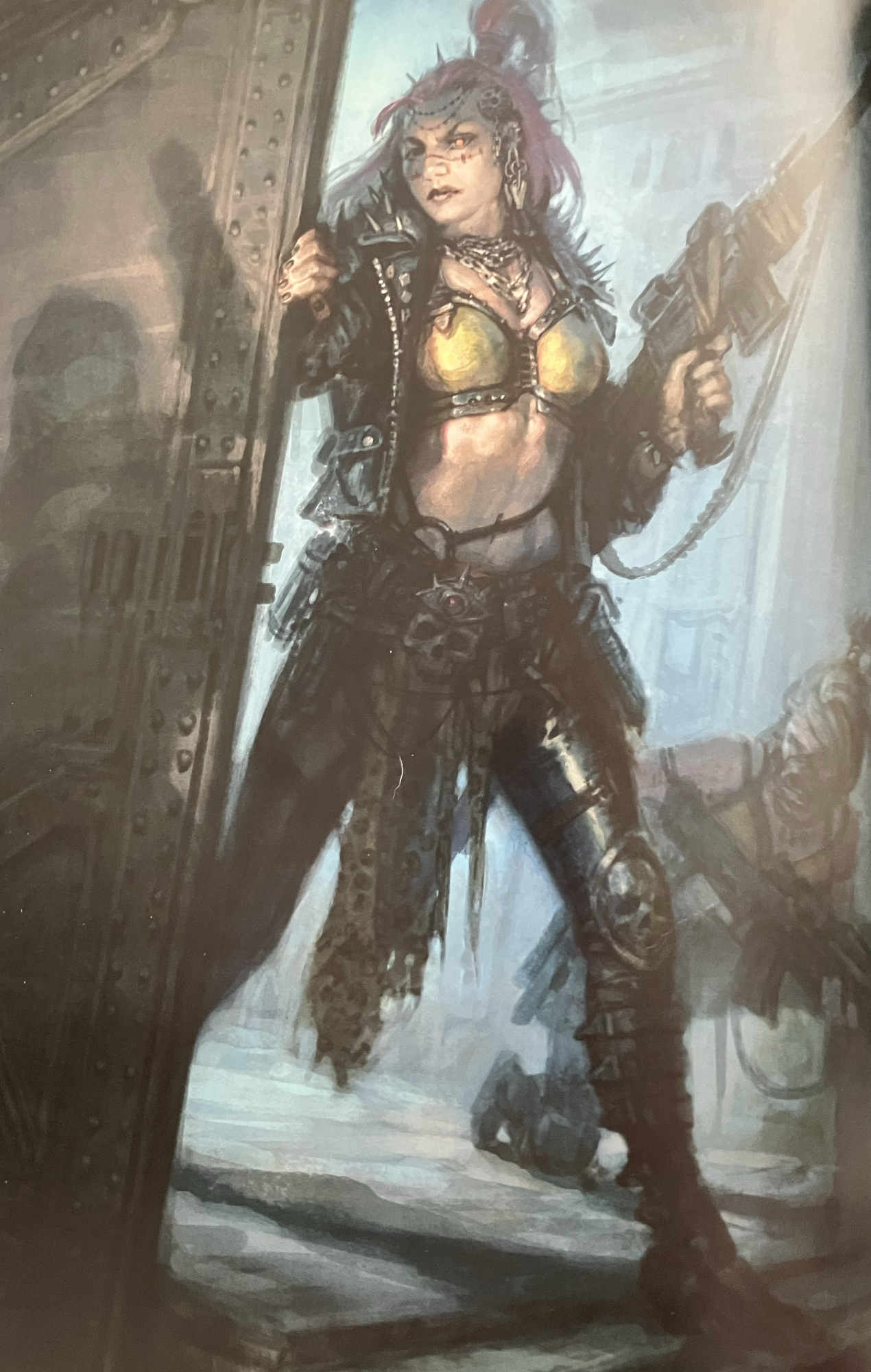
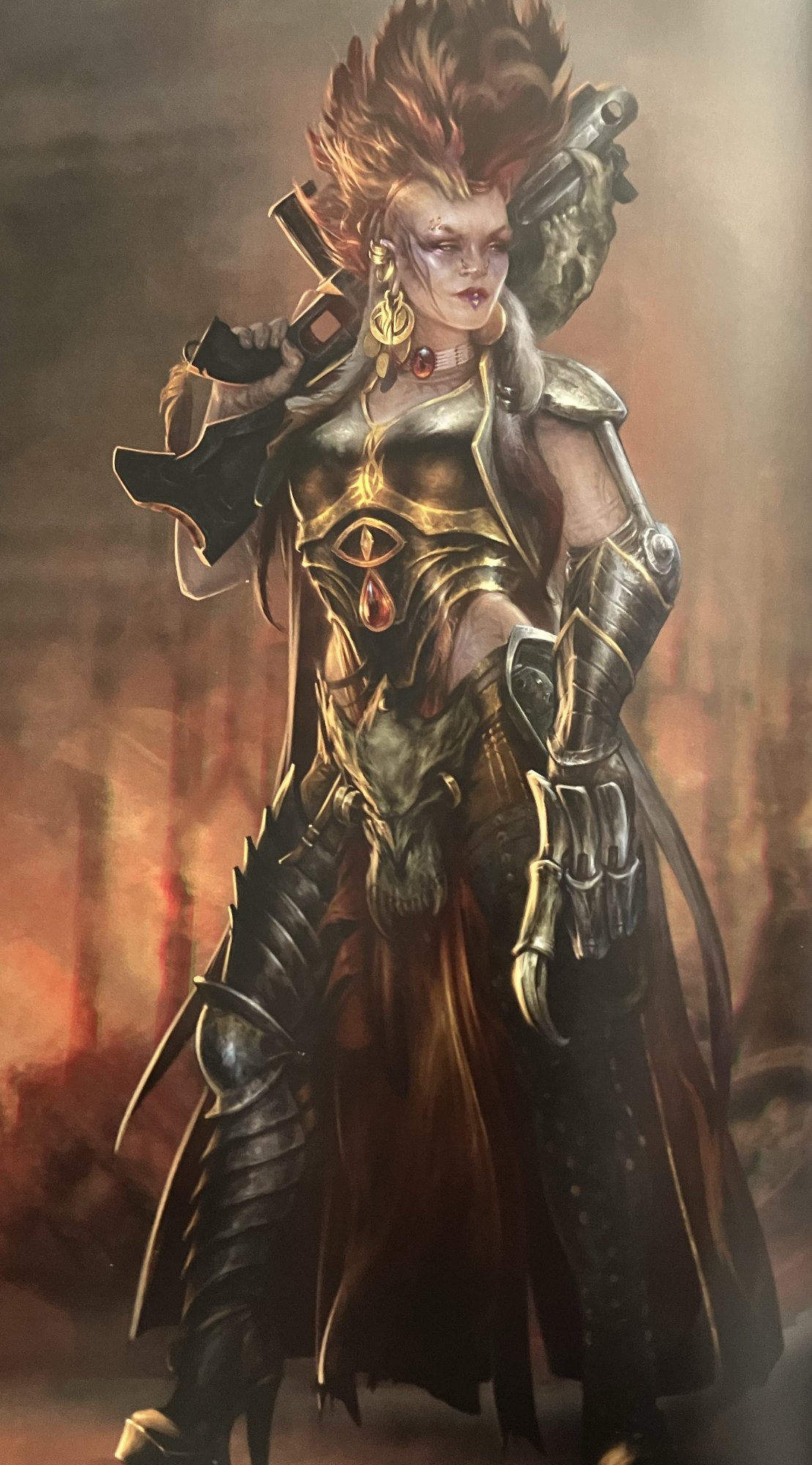
Better Advancements
There’s not a ton to say about advancements except that I really like the changes they made to the Advancement table. This is important because you’re not getting to choose your advancements any more if you’re basically anyone but a ganger. And the old Advancement table had some really bum options. The worst of which were the 8-9 and 10-11 rolls: 8-9 got you a +1 to Willpower or Intelligence while 10-11 got you a +1 to Leadership or Cool. Ugh…
Willpower can be important to Pskyer characters but they’re usually champions so they can select whether to improve this or not. But the number of times I’ve had a juve get an advancement only to get +1 to Leadership or Cool… the two most useless stats to a juve, are insanity. That someone planned out this table shows that even at high levels people can do stupid things.
The new table has only one entry that isn’t… great. 3-4 is +1 Cool or +1 Willpower.
I haven’t been through everything a hundred times yet, so I don’t know if Willpower gets used more often than it has in the past but Cool can at least be useful since you have to take a cool check when the guy next to you goes down. Sure, you don’t care if they’re a “prospect” but other prospects do and Escher Little Sisters only have a Cool stat of 6. So, at least this can be put to use. Everything else on the table are genuine options to choose from. And there are many more chances to add skills which is also nice as those will help differentiate one fighter from another over time.
In terms of the new Model Ranks system… I don’t really understand why raw numbers for XP is the determinant instead of the number of Advancements. I guess it does get harder to advance the higher up the ranks you go (a “rookie” improves every 3 XP while a “gang hero” requires 11) but it feels clunky. Especially with every fighter profile having a “Starting XP” stat that doesn’t mean anything except which rank you start at and how fast you can improve. But it definitely doesn’t mean you get to spend any of it.
At least I don’t think so… gang creation rules don’t seem to indicate that you do.
Which brings me to…
Gang Creation
This is a topic that I wanted to touch on because it both changed a lot and, fundamentally, not at all!
First of all, addressing the elephant in the room: juves. The term juve has gone away. I’d heard rumors that this was going to happen because it made GW uncomfortable with the association to child soldiers. But this is, frankly, stupid. The term juve has nothing to do with child soldiers. It didn’t even originate with Games Workshop but, instead, with the number one place they liked to steal ideas from: 2000 AD. After all, what is a hive city if not a City Block in Mega City. And if you read any Judge Dredd story, eventually you’ll read the term “juve”.
So if it’s true that GW is pissing themselves over child-soldier connotations, then that’s because they lack the backbone to just piss-off and go read some quality 1980s sci-fi comics.
But what’s interesting is while “juve” has gone away, the actual position hasn’t. Yes, they’re called a “prospect” now which is slightly more appropriate but they have the exact same stats they had in the last edition and earn twice as many XP as a normal ganger. And no one cares when they die. And they remain cheap as chips. So you can keep calling them juves because, functionally, they are.
So that’s not the thing that changed a lot.
The thing that changed is that weapons aren’t divided up by position any more. Theoretically, if you wanted to send out a gang of juves entirely armed with heavy stubbers and refractor fields, you could do it. Looking at the Escher list, in particular, there are only a couple of restrictions. The Wyld bow and Whip are both restricted to Wyld Runners while the Venom Claw is restricted to the Death Maiden. Other than that, anyone can apparently have anything.
The other big thing is that anyone above a prospect gets a skill. All the fighters that used to be bog standard gangers are now classed as “Ganger, Specialist” and, on hire, you can pick their specialty from one of eight different types. Each specialty comes with an associated skill.
I don’t know if these new skills will make a huge difference but it will allow people to run more thematic gangs. Why not give your angriest fighter Brawler so they Berserker and head-butt everything in sight?
It’s a neat new feature that I’m sure everyone will take advantage of. My favorite Escher gunner, Sunny, will probably wind up as a Gunner because that girl will stroll into any battle and happily light it up, shooting from the hip. In fact, Hip-shooting is such a neat skill, it’s entirely possible half the gang might get the Gunner skill. But I know I’ll be really curious to see how it shakes out.
Odds & Ends
This section is going to mostly be me bitching about things that got changed for change’s sake. Hopefully you’ll bear with me since I think I’ve been pretty even handed, not ranting and raving about much bigger changes just because they’re different. For Christ’s sake, I think I almost even complemented the new shooting mechanic! And that’s the one that everyone’s been all worried about!
My number one thing that I don’t know why they changed was turning damage into “lethality”. I mean, why? This feels like that trend where “to be kinder” people just add more words to a thing. They’re not homeless. They’re “an unhoused person”. Doesn’t matter that it’s the same fucking thing but, for some reason, more words are nicer.
A totally random thing, apparently gangers have learned to share!
In this case, lethality isn’t more words but it’s an awkward replacement for one that meant the same thing. How much damage does it do? You mean, what’s it’s lethality? Sure, yeah, its the same fucking thing, just answer the question. And by that I mean, if it hurts you, how bad does it hurt you?
Now, obviously, something with a “lethality” of 3 like a Mining Laser is more lethal. But it’s more lethal because it does more damage. But damage just seems more intuitive and, as a guy playing this game in Germany, it seems like “damage” would also be a lot easier for non-native English speakers to say. But, whatever, I guess…
Update 8/19/2026: Reader Imperial Dan points out that Lethality is different than Damage now as Damage has now become a weapon trait and he is correct! I had not noticed this.
Damage is now Damage (X) where (X) is the number of wounds it removes when successfully hit and unsuccessfully saved against. Lethality is now the number of Injury Dice you roll when you drop a fighter below zero wounds. So, to play this out, I have a 1 Would Fighter who gets hit by a Weapon with Rapid Fire (1) and Damage (2) and a Lethality of 1 (I’m making up this weapon…)
If I roll three hits and none of them are saved, this deals 6 damage but it’s handled separately since you really can’t get below zero wounds. So, hit one would drop the value to below zero. Then hits two and three would also drop it below zero a second and third time. Then, with a Lethality of 1, because the fighter fell to or below zero wounds three times it would be three Injury Dice, one for each hit. This is different than the old Murder Dice way where every wound that took a fighter to zero or below was an Injury Die.
Then, when the Injury Dice are rolled, if there is more than one, the attacker picks the one to apply. This matters because Flesh Wounds and Serious Injuries don’t stack any more.
I guess this adds a new diversity to weapons. It’s kind of like Toxin used to be. Toxin against the average ganger didn’t do much different from a standard round but, against a high wound stat fighter like a leader, champion, or brute, you could potentially one-shot them. With a high Damage (X) trait, you can still do this while the Lethality rule won’t necessarily take them out more than average. This is another one of those things it will be interesting to see play out as games start getting plaid.
I’m just sad to see Murder Dice essentially go away…
This isn’t a complaint but I’m glad to see they got rid of Convalescence on the Lasting Injury chart. It was confusing to have Going Into Recovery and Convalescence on the same chart and trying to remember which was which. Now, if you Go Into Recovery, you’re out until the next Cycle. Or it’s miss next game. However your group wants to play. But it’s one thing to remember. This is a streamlining like Simple versus Basic actions that I encourage because it’s fewer things to remember the fine points on.
A totally random thing, apparently gangers have learned to share! According to the Post-Cycle Sequence rules, fighters may now discard any wargear or weapons!
I was never really sure why this wasn’t a thing before. I had thought it was a way to make most models WYSIWYG since, if they’re carrying a plasma gun, you’re probably going to model them with a plasma gun. But I’ve never really played in any groups where proxying was a problem. Then I thought it was to maybe encourage more model building but I never really saw that pan out either. I don’t think there ever was a good justification for not sharing weapons except to maybe keep models’ value artificially high or gangs artificially expensive as more fighters were hired to carry a range of weapons. But I never saw the point of that.
So I’m glad this restriction has been lifted. I think it will make zero difference in-game but if you want to trade a stub gun from a champ to a juve, it feels like something you should be able to do.
It’s pretty clear that they don’t want people doing a lot of math when calculating their save rolls.
Lastly, let’s touch on armor. Oh boy, have they changed armor. The myriad types of armor that used to exist have been pared down to essentially Mesh (which is only used in Close Combat), Light Carapace (which only grants a +1), Heavy Carapace (which grants a +2), Hazard suit (which makes you invulnerable to Blaze and Rad-phage), a Reflect Shroud (no AP on las, plasma, or melta weapons), and a Refractor Field (which grants 5+ invulnerable). And it’s all gotten a lot more expensive. Mesh armor now costs 40cr while a Refractor Field costs 50cr. Light Carapace is 100cr!
It’s pretty clear that they don’t want people doing a lot of math when calculating their save rolls. Most models will have their base save and either a +1 or a +2 based on cover and range and then you’re rolling. This will be a lot faster, as I predicted it above. But I’ll be curious about the “lethality” of these changes on the longevity of our fighters.
Maybe it won’t be a big deal! Everyone essentially has free flak armor now. That was what most of my Escher fighters had. Hell, most of my outcasts weren’t even lucky enough to get that. But it’s kind of a bummer I can’t get armored undersuits or counter other types of damage like blast or flame the way flak used to. It does remove a little bit of color from the game and I’m not looking forward to the first time I take out an opponent’s champ with a lucky hit and they roll a 4 when they needed a 5+.
There are some interesting storytelling possibilities here. A juve that lucks out, hitting a champ on the roll of a 6, the champ that fails the save, what a hero! But having your most expensive fighter eliminated by the cheapest doesn’t always feel great, so I’m curious to see how this plays out in the long term.
Gangs Comparisons
I had thought that something that might be fun to do would be to rebuild a few of my gangs and compare and contrast them in the old rules to the new. It obviously won’t be an exact one-to-one comparison since there are some changes. But this article is long enough and that will take some additional time. So look for these to come out every couple of days as I think it’ll be illustrative as to how they changed the game.
Spoilers for the first one though, one thing I’ve already noticed is that weapons that used to come only on a resin weapon’s sprue are generally no longer valid in the new rules. And the big one here is for Escher. Escher actually did have a grenade launcher but it only came on the Escher Leaders & Champions resin kit. As far as I can tell, that kit is no longer being made. And they never put it out on the plastic extra weapons sprue. So guess what’s no longer on the Escher house list?
I think as we go through the various gangs, especially the house gangs, we’re going to find that this is more and more the case.
Or I could be entirely wrong! Maybe when the journals start coming out, we’ll see some additional weapons. I’m certainly hoping for the chem-synth to be returned, especially since they keep sculpting it even on the new models, and that didn’t make the new house list in Gangs of the Underhive. So we shall see.
Wrap Up!
Woa, Nelly! Not a short piece of work, this. But, then, we got an entirely new edition of a game I am… very passionate about. If you ask my wife, she might joke that sometimes she thinks it might rank above her and our dog. Which are the two things I really do care about the most. But Necromunda is something I enjoy very, very much.
As such, walking through all of these changes has been enlightening, both in that I really got to see where the game changed the most, where it changed the least, and resolve a bunch of my worries about any of the changes because, working through them, nothing feels that drastic. There are changes, as I’ve pointed out, and shooting (a core part of any skirmish game) definitely was revised. And I’m still curious to actually try it on a table. But I don’t think it’ll be nearly the massive change to the system as people had worried.


Damage still exists; it’s now a weapon Trait, as in “Damage 3”.
Lethality is a different thing; it determines the amount of Injury dice rolled when a character gets to 0 Wounds, unlinked to Damage.
Good point! I hadn’t noticed that Damage was moved to be a trait. Let me look at it and I’ll update the post.