I was playing a game in my N23 Cinderak City campaign against the arbitrator when he asked me if I’d heard about Black Death City. As it happened, I’d just seen a YouTube video about it that morning. This is how I stay up to date on hobby stuff. I work out on my elliptical in the morning and watch YouTube videos. Because I could be learning something or I could be watching painting videos…
I was already curious because the couple of videos that I’d seen compared it favorably to Mordheim, a game that came out just after I’d left the hobby in the 90’s. Mordheim, like veganism, is something people who are involved with won’t stop talking about. I could tell a story about the time I shook hands with Ron Perlman on the A-train platform at West 4th St and they would relate it back to Mordheim somehow. But, god bless. It’s not like I don’t have a game or two I really like.
Mordheim was a fantasy skirmish game GW put out in the mid- to late-90’s that has always read very much like Necromunda. I’ve never delved too deep into the rules but, from what I saw, they were very much like the N95 rules. And, of course, it was fantasy. Set in the ruined city of Mordheim, adventurers battled it out for something or other… doesn’t really matter. You had a crew, they had a crew… fight!
Unlike Necromunda, GW has never gotten around to releasing a new edition of the game. So people who love it are still playing the old rules! Now that’s dedication… But a quick look online really does show that people are still very much in love with the game. And the advent of 3D-printing hasn’t hurt things in the least.
All of which brings us around to Black Death City, a new skirmish game developed by Sam Pearson, a former games designer at GW responsible for Warcry and Age of Sigmar: Spearhead. Not a bad legacy, if you ask me. I was always interested in Warcry but the game kind of passed me by. Also, cards on the table, I’m not really a fantasy guy. Sure, I like my Cursed City and I put Lord of the Rings on TV when I’m sick but, in my heart of hearts, I’m a sci-fi guy. So, given the choice between a desperate battle between gangs in the underhive and forces of chaos duking it out in some mystical setting, well…
But Black Death City caught my attention for the same reason Cursed City interests me. It kind of crosses the fantasy/horror line into something that, once more, piques my interest. So I took a look at the rules (which you can too by signing up for the newsletter on the Black Death City website). In the interests of fairness, the rest of this article will look at the rules with the same distance that I did N26 in the rules exploration article I wrote over launch weekend. I’m looking at mechanics and guessing at gameplay ramifications but, since I haven’t yet had a chance to play the game, these are all really just observations at this point and not even criticisms. That, I shall refrain from until I actually play a game.
All of that said, let’s look at it!
The World
There have been a lot of comparisons made between Black Death City and Mordheim for one very, very important reason: Black Death City seems to be very much inspired by the older game. The first line of the overview pretty much says it all:
Black Death City is a skirmish wargame where warbands of vying factions battle in the darkness of a ruined city
for glory and fortune.
Skirmish, warbands, ruined city…? Check, check, and check.
Again! Not criticism! If GW is going to leave a haunted fantasy gothic city skirmish setting lying on the ground, I don’t blame anyone for trying to pick it up. Then there are the announced factions:
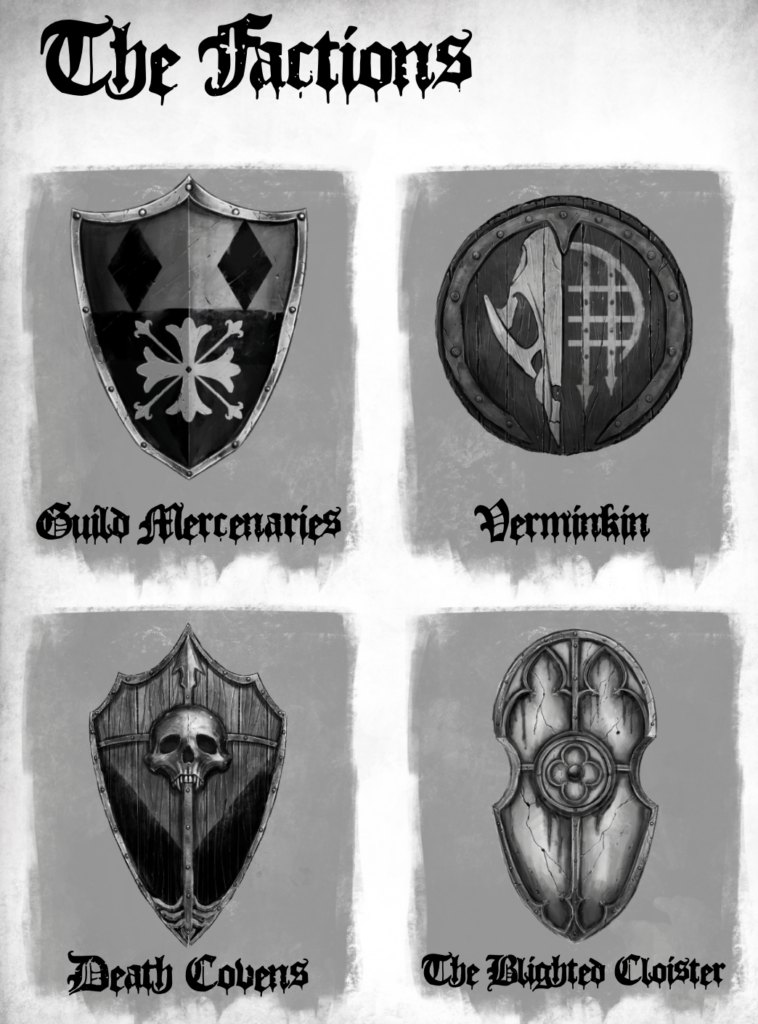
Pearson has said that he intends to add four more factions to the game but, even as is, this covers a lot of bases. With Guild Mercenaries we have a basic human hero faction, which makes them sound more boring than it should. These are the armored dudes there with everyday stuff ready to do battle. I’m in. Then there are the Verminkin, the rat-people. Just don’t say “Skavin”. The Death Covens look to be undead noble creatures. And the Blighted Cloister are some kind of demon worshiping fallen Knights Templar thing. Very cool! All around!
I’m not really sure the game needs four more factions but if Pearson feels like pumping it out, I’m always into variety.
Character Creation
Just looking quickly at the character sheets should ring a lot of bells for anyone who’s been anywhere near a GW skirmish game lately. And by that I mean if anyone who’s been playing Mordheim has been playing Kill Team or N26 Necromunda, bringing your warbands over and playing a game should be pretty easy. Let’s just look at the sample character table:
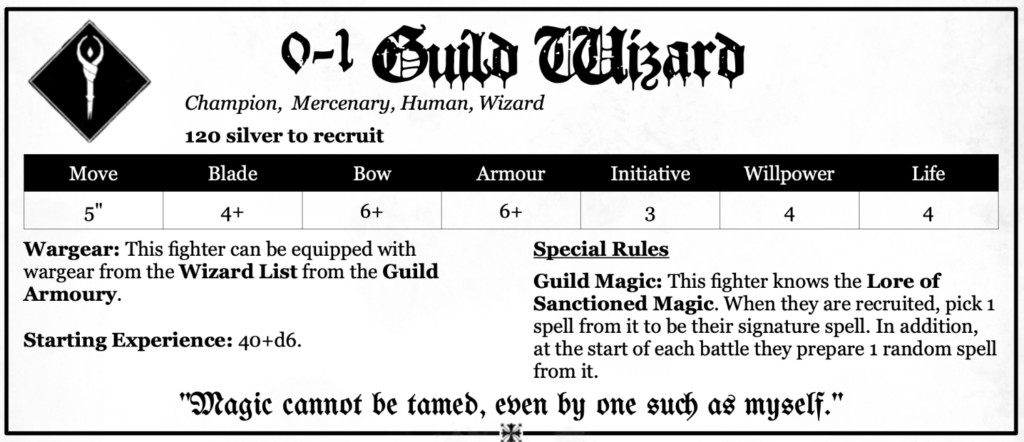
Replace Blade and Bow with WS and BS and any player of just about any GW game should know what’s happening. Armor, in this case, functions like the new Necromunda character Save while Life is functionally the number of “wounds” a fighter has.
There are a couple of tweaks, naturally. In this case, the “attacks” characteristic every fighter in Necromunda has is not a fighter stat but a weapon stat instead. This actually makes a lot of sense as most of the melee weapons have multiple attacks available while most of the ranged weapons only have one. (No doubt because machine guns aren’t usually a thing in fantasy settings.) This could almost apply to Necromunda where, even with Rapid Fire, without any additional skills a fighter only gets to shoot once but can attack with a knife multiple times. And, yet, in Necromunda, this is a character stat.
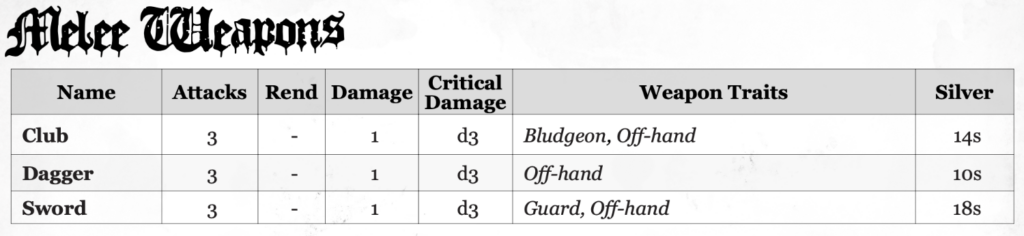
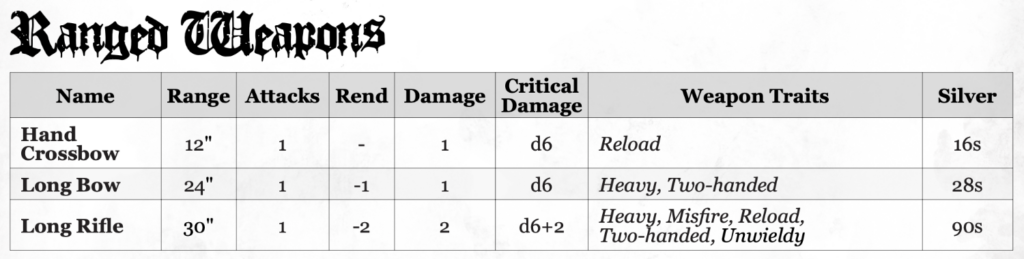
Again, as a GW skirmish game player, even though I know I’m looking at something different, I’m also not confused by what I see. I feel like I could take my existing knowledge and map it onto this with little to no adjustment time.
Activations
Like most skirmish games, Black Death City has limited each fighter to just two actions per activation. (With an exception to be addressed in a moment.) And each of these actions can be done only once. But, interestingly, Pearson has decided to add a little twist by making one of those actions a move action and one a more generic action. So a fighter can do a move and hide or a disengage and ranged attack.
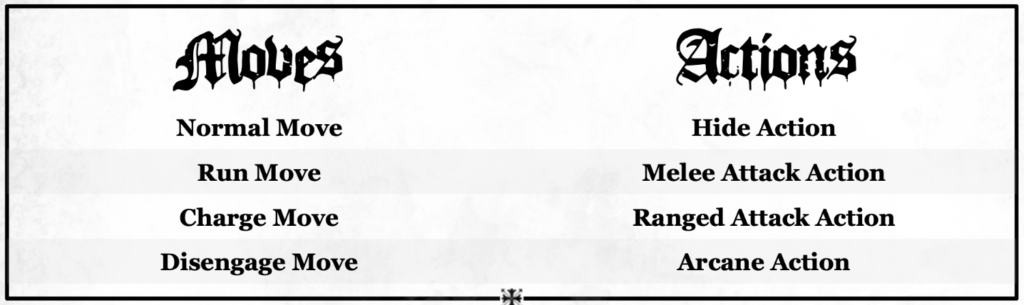
On first reading, I wasn’t a fan of this idea. But the more I played with it in my head, the more cinematic I found the idea. With everyone having a move and another action, we can have fighters charge into combat in one round and then pull away and fire a pistol at the person they were just sword fighting in the next. It could give a real sense of dynamism to the battles as fighters aren’t just locked into one type of fighting. But, on the other side, it’s not so silly that people will be comparing it to Yoda bouncing off the fucking walls in Attack of the Clones.
Giving everyone a move action as part of their activation also encourages players to constantly be surging their fighters forward and I think that’s a great thing for a skirmish game. What you don’t want is for it to devolve into battle lines of fighters sniping at one another. And since this game encourages warbands of up to twelve fighters, that could wind up being a lot of potshots being taken. This rule, instead, encourages fighters to surge forward and actually get into the action of things.
Speaking of which, this game has a concept called “Surge Activations.” This is something I’ve seen in games like Fireteam where, in order to balance out the activation economy a little between differing sized warbands, the player with the fewest number of fighters can re-activate a fighter to perform one more action that battle round. I understand the impulse to add a rule like this. There have been times when playing Necromunda when I’ve seen a gang so depleted that they only have a handful of fighters trying to make a last stand against a half-dozen enemies slowly encircling them and visions of Little Big Horn were no doubt running through their heads. But there are usually other ways to balance this.
As mentioned previously, this game expects a fairly large number of fighters in every warband, probably ten minimum and maybe up to a dozen. That’s a large number of activations per round. And then re-activating a few just adds to this time.
One of the things I liked about the old N23 scenario rules was that an underdog could often look for a scenario that only required five fighters on each side. Which worked for a gang that might have a fair number of gangers in recovery. It also forced the stronger player into a situation where their gang value mattered less. Reading through the scenario rules for Black Death City, it looks as if every scenario requires the entire available warband to be fielded.
Now, to be fair, there are only a handful of scenarios at this point. It’s more than likely that more are coming and that this mechanic might be introduced in the very near future. So this is in no way criticizing the game as a whole. But the surge mechanic does add extra activations and with so many fighters, it could significantly add to the length of the game.
Battle Mechanics
There were only two things that jumped out at me with the mechanics of battle in this game. The first was the melee attack-parry rule. The idea is that, in melee, both fighters are dealing blows and responding to potential hits at the same time. So this mechanic is designed to incorporate that level of simultaneous action into the game.
Essentially, both fighters roll their available attacks. The fighter with the highest initiative then decides how to deal with them, in this case, attack. The lower initiative fighter can then use a successful attack roll to parry (and possibly deflect damage) or to tank the damage and hit back with an attack of his own. This goes back and forth until one fighter runs out of attacks, in which case the opposing fighter can deal out the rest of theirs, or a fighter succumbs to his wounds.
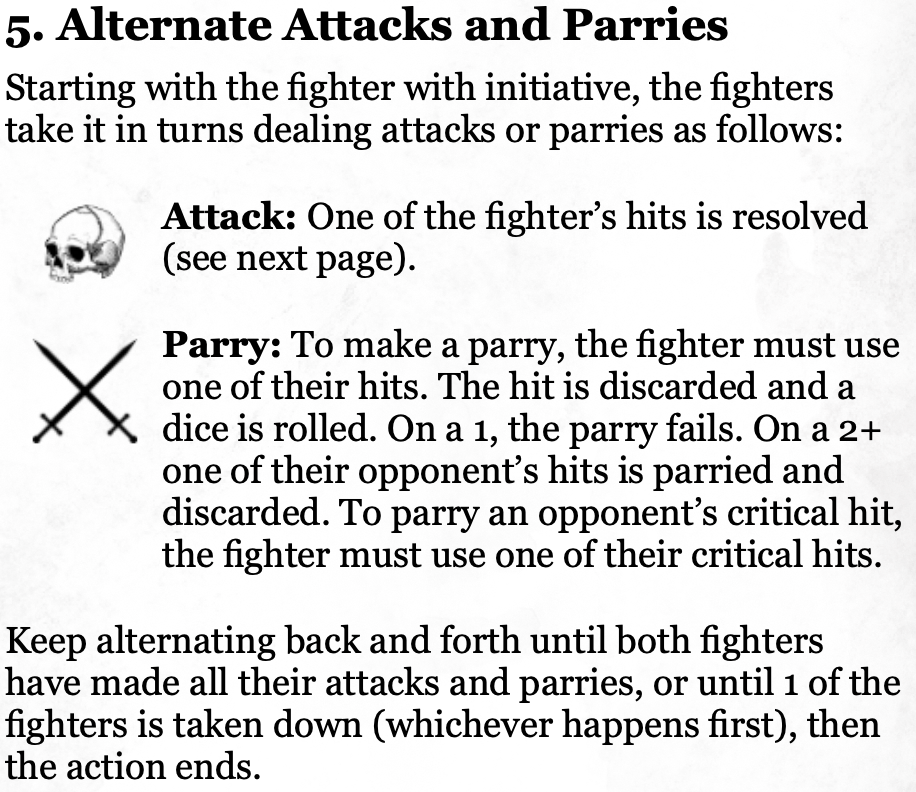
I’ve played with this mechanic before in the Darktide miniatures game and I’m of two minds with it. On the one hand, I like to imagine the struggle between two swordsmen, dealing out and deflecting hits. On the other, it takes a really creative mind to see the dice-matching session as more than a competitive form of Yahtzee. Because that’s what it really comes down to. We each have a pool of hits, some are crits, and then we pair them off until the odd one out has more and can deliver a blow.
The one aspect to the Black Death City rules I really like is that even with a matching parry, a roll on a die still has to happen. Sure, a 2+ is a success but I’ve played enough Blood Bowl to know that that 1 will come when you want it least. So, in this respect, it’s better than Darktide’s in that there’s still a chance a swordsman who should have parried a blow gets sliced by it instead.
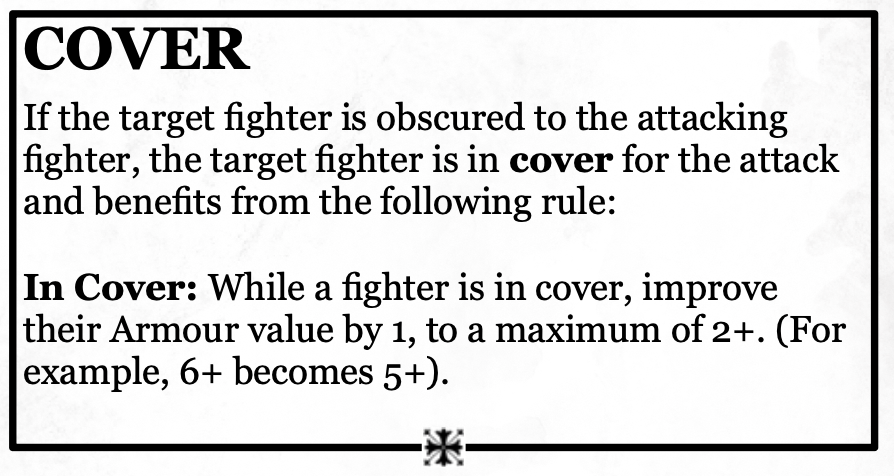
The last thing I wanted to note was the cover rule. Not because it’s groundbreaking but more just to use it as an illustration of the fact that game design seems to have trends and fashion like everything else.
I will admit, my experience with table top skirmish games is pretty limited but I do find it interesting that this game comes out shortly after the N26 edition is released where the rules operate in a very similar way. I cast no aspersions on anyone here, just noting the similarity. And it’s probably for a very good reason. There are only so many shops out there actively creating new games that are played by wide audiences. Games Workshop is definitely one of them and Sam Pearson came out of the design team. People are influenced by their friends and co-workers all of the time. It’s why similar music groups hit the scene in the same cities in the same years as one another.
Prior to N26, I was used to cover being an independent thing from armor. It affected hit rolls, not save rolls. Now it seems like I’m seeing more and more games where to hit is based solely on the skill statistic and, instead, it protects fighters more like armor used to.
Fascinating.
Wrapping Up!
I have to say, despite the fact that I really only have a desire to play one game these days, I am very interested in Black Death City. And because of a prevalence of alternative miniature makers like War Games Atlantic, I’m actually kind of interested in putting together a warband and getting one painted up in case anyone in any of my groups is interested in hosting a game.
The one thing I will say is that I’m not very interested in investing a lot of other time or effort into it though. Unless I start playing with a group that is as rabid about Black Death City as, say, my average Necromunda group, I won’t be building out whole tables of terrain and mocking up whole blocks of some cobblestone fantasy city. It’s not that the setting doesn’t appeal, it’s just that I’m invested in another game system that I already have dozens of people wanting to play regularly.
That said, I am signed up for the mailing list and I will be following the evolution of the rules closely in the hope that, as the game develops, it picks up a following. Because I know some Mordheim players here in Hamburg. And if they switched over to this… I might want to get in on the action.