This review will encompass the novel and audiobook of Daemonbreaker by Jude Reid. It will cover themes and plot points discussed early in the novel but none so many or so deep it would spoil a reader any more than flipping through the book at an airport bookstore.
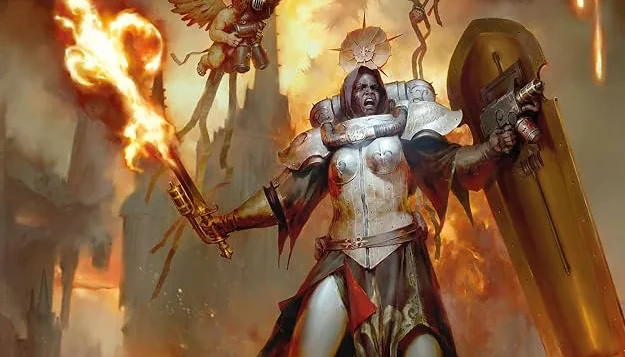
I’ve said in the past that I have a weakness for Sororitas stories. There’s something about ordinary, non-enhanced women who so believe in their God-Emperor that they’re out among the stars with flamer and bolter trying to cleanse world in “holy violence.” And, because I’d read a Daemonbreaker story by Jude Reid in the short-story collection, Paragon of Faith, I thought I’d give the novel by the same name a shot.
There are Black Library books that are very self-contained stories. They have the traditional beginning, middle, and end. Books like The Rose at War are like this. Typically, they’re not tied to a particular game or setting release and, so, they’re a little more standard in their storytelling format even if set in the 40k universe. Then there are books that are centered around the release of a new box, like the 40k: Armageddon box or Cursed City or Blackstone Fortress. And these books tend to be long set pieces. Character work seems second to setting the scene.
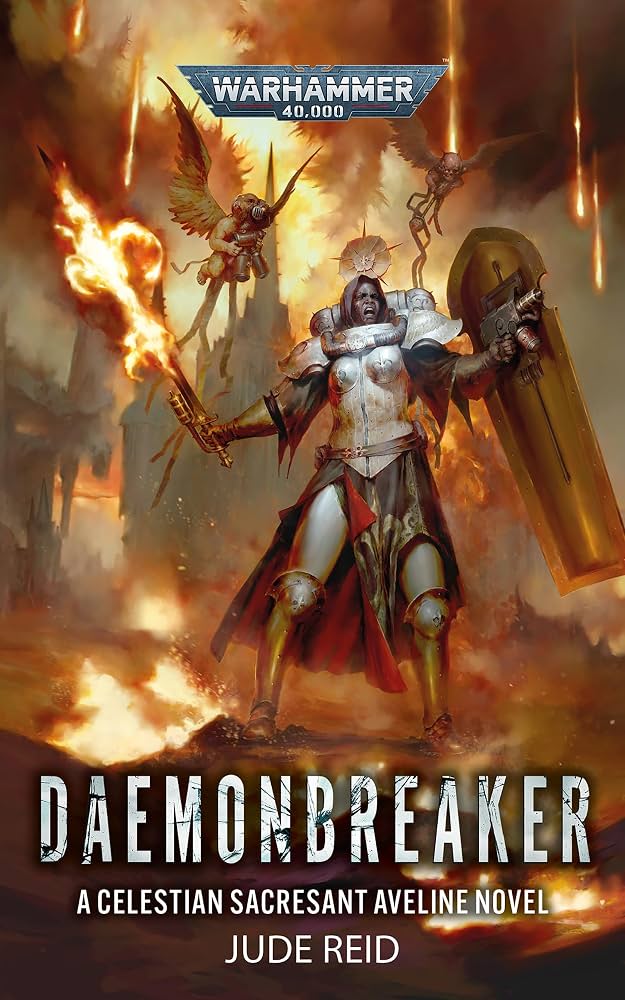
Daemonbreaker, to me, seems to sit right in the middle of these two kinds of books. There is a lot more work put into introducing the characters and finding out who they are but the setting is fairly limited and more or less moves from set piece battle to set piece battle with just enough character interaction for the reader to understand why the next fight is important. This might sound dismissive but I don’t mean it to be because Daemonbreaker had some remarkably good characters and interactions that do make it worth reading. But it isn’t a classic.
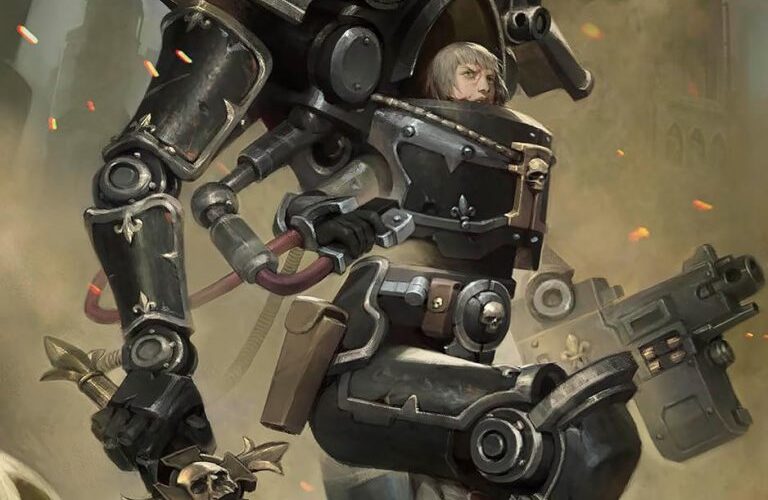
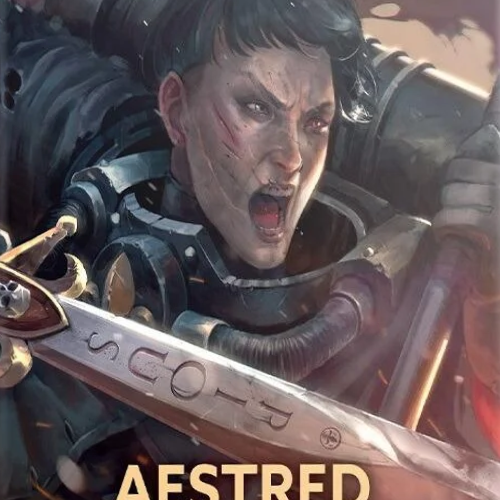
The story opens with Celestian Sacresant Aveline dispensing justice with her power-mace, crushing cultist skulls and looking for glory for the God-Emperor. For once, she seems less inclined to be worried about whether she’s worthy to be in His service than if she’s bringing enough glory to His name. Meanwhile, Initiate Gwineth, a girl on the verge of taking her holy orders, prays that she can die in His service before her haemophilia gets her first.
In Gwineth, we have the best character development. Early on, as the sisters are attacked, she defies her orders and joins Aveline’s company in an attempt to repel the enemy only to mess up in a very serious way. But it’s easy for the reader to understand her eagerness. One wrong blow and she will bleed to death. Better to die swinging than otherwise.
the number of non-petty canoness characters in Sororitas books remains at zero
This leads her to being assigned to Aveline as punishment, both for the initiate and for Aveline as the number of non-petty canoness characters in Sororitas books remains at zero. Aveline and Gwineth are then assigned to track down a Chaos sorcerer with a small company of battle sisters while the rest of the Sororitas head off to defend Cadia.
And we all know how well that last thing goes.
Daemonbreaker isn’t the kind of book that gets tricky with its mystery. It’s a walk through a very bloody garden path, first looking for the sorcerer, then finding him, then fighting him, then on to the next plot point. But that’s not to say it’s not well executed. And the dialog between the characters is very good, very natural, and has much less repetition than, say, the Rose books, which I otherwise very much enjoy.
I also listened to the audio version of this story because I like to listen to things as I paint miniatures. Narrator Faith Alabi does an excellent job with the story, differentiating characters well so it’s never confusing who is in a scene. This is extra important in a story like this where all the characters address each other as “sister” and praise the God-Emperor on the regular. Knowing who is saying what is, frankly, key to understanding the story.
I was a little surprised that they used voice effects at various times, given that Alabi was so effective, but it’s sci-fi, so it’s not terribly distracting and lends it a tiny bit more of an audio drama quality than just an audiobook.
All in all, as the second Jude Reid story I’ve read, I have to admit I’m curious to read more. She’s a fun writer who brings a great voice to characters that could otherwise come off as flat in a less capable writer’s hands. And, for someone who is already a fan of the Sororitas, Daemonbreaker is an easy book to recommend. But, even for people who prefer more traditional stories, this isn’t nearly as flat as the typical setting-style book.